


Page 511 - Le Operazioni Interforze e Multinazionali nella Storia Militare - ACTA Tomo II
P. 511
1151
          ActA
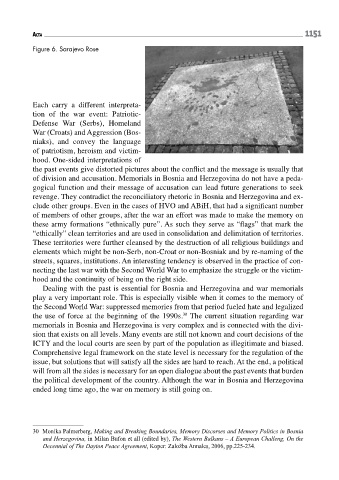
          Figure 6. Sarajevo Rose


          Each  carry a different  interpreta-
          tion  of  the  war  event:  Patriotic-
          Defense  War (Serbs), Homeland
          War (Croats) and Aggression (Bos-
          niaks), and convey the language
          of patriotism, heroism and victim-
          hood. One-sided interpretations of
          the past events give distorted pictures about the conflict and the message is usually that
          of division and accusation. Memorials in Bosnia and Herzegovina do not have a peda-
          gogical function and their message of accusation can lead future generations to seek
          revenge. They contradict the reconciliatory rhetoric in Bosnia and Herzegovina and ex-
          clude other groups. Even in the cases of HVO and ABiH, that had a significant number
          of members of other groups, after the war an effort was made to make the memory on
          these army formations “ethnically pure”. As such they serve as “flags” that mark the
          “ethically” clean territories and are used in consolidation and delimitation of territories.
          These territories were further cleansed by the destruction of all religious buildings and
          elements which might be non-Serb, non-Croat or non-Bosniak and by re-naming of the
          streets, squares, institutions. An interesting tendency is observed in the practice of con-
          necting the last war with the Second World War to emphasize the struggle or the victim-
          hood and the continuity of being on the right side.
             Dealing with the past is essential for Bosnia and Herzegovina and war memorials
          play a very important role. This is especially visible when it comes to the memory of
          the Second World War: suppressed memories from that period fueled hate and legalized
                                                     30
          the use of force at the beginning of the 1990s.  The current situation regarding war
          memorials in Bosnia and Herzegovina is very complex and is connected with the divi-
          sion that exists on all levels. Many events are still not known and court decisions of the
          ICTY and the local courts are seen by part of the population as illegitimate and biased.
          Comprehensive legal framework on the state level is necessary for the regulation of the
          issue, but solutions that will satisfy all the sides are hard to reach. At the end, a political
          will from all the sides is necessary for an open dialogue about the past events that burden
          the political development of the country. Although the war in Bosnia and Herzegovina
          ended long time ago, the war on memory is still going on.


          30  Monika Palmerberg, Making and Breaking Boundaries, Memory Discorses and Memory Politics in Bosnia
             and Herzegovina, in Milan Bufon et all (edited by), The Western Balkans – A European Challeng, On the
             Decennial of The Dayton Peace Agreement, Koper: Založba Annales, 2006, pp.225-234.

