


Page 509 - Le Operazioni Interforze e Multinazionali nella Storia Militare - ACTA Tomo II
P. 509
1149
          ActA
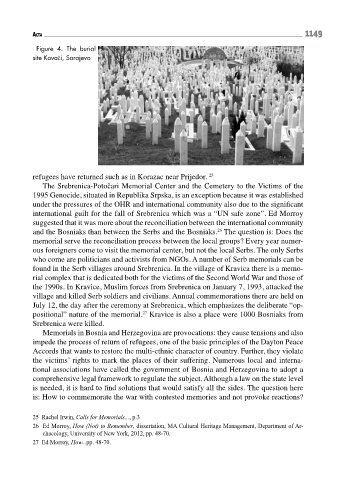
           Figure 4. The burial
          site Kovači, Sarajevo


          refugees have returned such as in Korazac near Prijedor.  25
             The Srebrenica-Potočari Memorial Center and the Cemetery to the Victims of the
          1995 Genocide, situated in Republika Srpska, is an exception because it was established
          under the pressures of the OHR and international community also due to the significant
          international guilt for the fall of Srebrenica which was a “UN safe zone”. Ed Morroy
          suggested that it was more about the reconciliation between the international community
          and the Bosniaks than between the Serbs and the Bosniaks.  The question is: Does the
                                                               26
          memorial serve the reconciliation process between the local groups? Every year numer-
          ous foreigners come to visit the memorial center, but not the local Serbs. The only Serbs
          who come are politicians and activists from NGOs. A number of Serb memorials can be
          found in the Serb villages around Srebrenica. In the village of Kravica there is a memo-
          rial complex that is dedicated both for the victims of the Second World War and those of
          the 1990s. In Kravice, Muslim forces from Srebrenica on January 7, 1993, attacked the
          village and killed Serb soldiers and civilians. Annual commemorations there are held on
          July 12, the day after the ceremony at Srebrenica, which emphasizes the deliberate “op-
                                          27
          positional” nature of the memorial.  Kravice is also a place were 1000 Bosniaks from
          Srebrenica were killed.
             Memorials in Bosnia and Herzegovina are provocations: they cause tensions and also
          impede the process of return of refugees, one of the basic principles of the Dayton Peace
          Accords that wants to restore the multi-ethnic character of country. Further, they violate
          the victims’ rights to mark the places of their suffering. Numerous local and interna-
          tional associations have called the government of Bosnia and Herzegovina to adopt a
          comprehensive legal framework to regulate the subject. Although a law on the state level
          is needed, it is hard to find solutions that would satisfy all the sides. The question here
          is: How to commemorate the war with contested memories and not provoke reactions?

          25  Rachel Irwin, Calls for Memorials..., p.3
          26  Ed Morroy, How (Not) to Remember, dissertation, MA Cultural Heritage Management, Department of Ar-
             chaeology, University of New York, 2012, pp. 48-70.
          27  Ed Morroy, How...pp. 48-70.

