


Page 505 - Le Operazioni Interforze e Multinazionali nella Storia Militare - ACTA Tomo II
P. 505
1145
          ActA
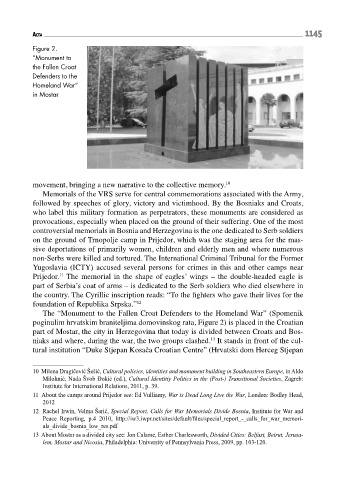
          Figure 2.
          “Monument to
          the Fallen Croat
          Defenders to the
          Homeland War”
          in Mostar


          movement, bringing a new narrative to the collective memory. 10
             Memorials of the VRS serve for central commemorations associated with the Army,
          followed by speeches of glory, victory and victimhood. By the Bosniaks and Croats,
          who label this military formation as perpetrators, these monuments are considered as
          provocations, especially when placed on the ground of their suffering. One of the most
          controversial memorials in Bosnia and Herzegovina is the one dedicated to Serb soldiers
          on the ground of Trnopolje camp in Prijedor, which was the staging area for the mas-
          sive deportations of primarily women, children and elderly men and where numerous
          non-Serbs were killed and tortured. The International Criminal Tribunal for the Former
          Yugoslavia (ICTY) accused several persons for crimes in this and other camps near
                  11
          Prijedor.  The memorial in the shape of eagles’ wings – the double-headed eagle is
          part of Serbia’s coat of arms – is dedicated to the Serb soldiers who died elsewhere in
          the country. The Cyrillic inscription reads: “To the fighters who gave their lives for the
          foundation of Republika Srpska.” 12
             The “Monument to the Fallen Croat Defenders to the Homeland War” (Spomenik
          poginulim hrvatskim braniteljima domovinskog rata, Figure 2) is placed in the Croatian
          part of Mostar, the city in Herzegovina that today is divided between Croats and Bos-
                                                             13
          niaks and where, during the war, the two groups clashed.  It stands in front of the cul-
          tural institution “Duke Stjepan Kosača Croatian Centre” (Hrvatski dom Herceg Stjepan

          10  Milena Dragičević Šešić, Cultural policies, identities and monument building in Southeastern Europe, in Aldo
             Milohnić, Nada Švob Đokić (ed.), Cultural Identitiy Politics in the (Post-) Transitional Societies, Zagreb:
             Institute for International Relations, 2011, p. 39.
          11  About the camps around Prijedor see: Ed Vulliamy, War is Dead Long Live the War, London: Bodley Head,
             2012
          12  Rachel Irwin, Velma Šarić, Special Report, Calls for War Memorials Divide Bosnia, Institute for War and
             Peace  Reporting,  p.4  2010,  http://iw3.iwpr.net/sites/default/files/special_report_-_calls_for_war_memori-
             als_divide_bosnia_low_res.pdf
          13  About Mostar as a divided city see: Jon Calame, Esther Charlesworth, Divided Cities: Belfast, Beirut, Jerusa-
             lem, Mostar and Nicosia, Philadelphia: University of Pennsylvania Press, 2009, pp. 103-120.

