


Page 111 - The Secret War in the Italian front in WWI (1915-1918)
P. 111
CHAPTER SIX


                                                          Telecommunications and Intelligence


                  6.1  MILITARY COMMUNICATION MEDIA

                  From the early phases of war, Italian army exploited various communication tools which allowed
                  orders transmission along the chains of command, requests and information from first line to the
                  Headquarters, actions coordination between infantry and artillery on the battlefields, etc. The
                  application fields of those media rested on their different characteristics, briefly illustrated in what
                  follows and including the maximum reachable distances, the transmission speeds, and the capacity
                  of preserving the secrecy. However, their joint employment was also envisaged for increasing the
                  survivability of connections among the combat units, even in the most difficult circumstances.


                  “classIc” MeThods for dIsPaTch TransMIssIon

                  The oldest way to transmit orders and
                  communications  on  battlefields  is  the
                  use of dispatch  couriers  who, also during
                  the  WWI,  carried  a  large  amount  of
                  written  and,  at  times,  oral  messages.  The
                  messengers, when travelling by horse,
                  bicycle, motorcycle, etc. certainly achieved
                  a faster transfer of dispatches, but enemy
                  fire and the risk of being captured remained
                  an obstacle,  especially  along unprotected
                  routes. Therefore, relay couriers were often
                  employed as the ultimate resource in default
                  of other faster and safer communication
                  means.
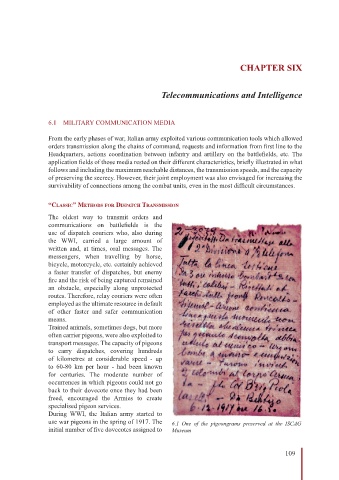
                  Trained animals, sometimes dogs, but more
                  often carrier pigeons, were also exploited to
                  transport messages. The capacity of pigeons
                  to  carry  dispatches,  covering  hundreds
                  of kilometres  at  considerable  speed - up
                  to  60-80  km  per  hour -  had  been  known
                  for  centuries.  The  moderate  number  of
                  occurrences in which pigeons could not go
                  back to their dovecote once they had been
                  freed, encouraged the  Armies to create
                  specialised pigeon services.
                  During  WWI,  the  Italian  army  started  to
                  use war pigeons in the spring of 1917. The   6.1  One  of  the  pigeongrams  preserved  at  the  ISCAG
                  initial number of five dovecotes assigned to   Museum


                                                                                                     109

