


Page 114 - The Secret War in the Italian front in WWI (1915-1918)
P. 114
THE SECRET WAR ON THE ITALIAN FRONT IN WWI (1915 – 1918)


              or other telecommunications  circuits,  without forgetting  the potential  exposure to enemy
              eavesdropping.
              Telegraph communications, unlike telephone communications, needed specialized personnel and
              relatively longer time for transmitting messages, especially encrypted ones, but telegrams recorded
              on paper tape were a written documentation, more difficult to contest than phonograms. Due to the
              time needed for transmission and the potential complications just described, electrical telegraphy
              had a larger diffusion across long distances and between high commands down to division-level
              than on the front first line.
              Telephone  communications  also  had  some  downsides, as  the  voice  transmission  impairment
              due to the battle noise and the talking difficulty when wearing anti-gas masks. However, despite
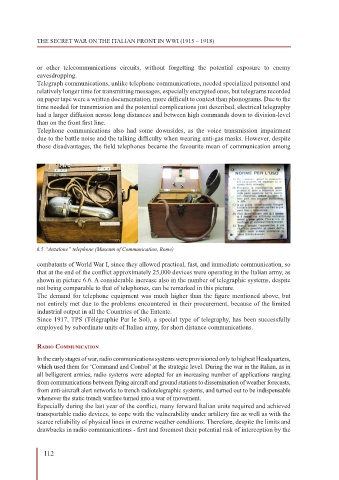
              those disadvantages, the field telephones became the favourite mean of communication among


              6.5 “Anzalone” telephone (Museum of Communication, Rome)

              combatants of World War I, since they allowed practical, fast, and immediate communication, so
              that at the end of the conflict approximately 25,000 devices were operating in the Italian army, as
              shown in picture 6.6. A considerable increase also in the number of telegraphic systems, despite
              not being comparable to that of telephones, can be remarked in this picture.
              The demand for telephone equipment was much higher than the figure mentioned above, but
              not entirely met due to the problems encountered in their procurement, because of the limited
              industrial output in all the Countries of the Entente.
              Since 1917, TPS (Télégraphie Par le Sol), a special type of telegraphy, has been successfully
              employed by subordinate units of Italian army, for short distance communications.


              radIo coMMunIcaTIon

              In the early stages of war, radio communications systems were provisioned only to highest Headquarters,
              which used them for ‘Command and Control’ at the strategic level. During the war in the Italian, as in
              all belligerent armies, radio systems were adopted for an increasing number of applications ranging
              from communications between flying aircraft and ground stations to dissemination of weather forecasts,
              from anti-aircraft alert networks to trench radiotelegraphic systems, and turned out to be indispensable
              whenever the static trench warfare turned into a war of movement.
              Especially during the last year of the conflict, many forward Italian units required and achieved
              transportable radio devices, to cope with the vulnerability under artillery fire as well as with the
              scarce reliability of physical lines in extreme weather conditions. Therefore, despite the limits and
              drawbacks in radio communications - first and foremost their potential risk of interception by the


                112

