


Page 112 - The Secret War in the Italian front in WWI (1915-1918)
P. 112
THE SECRET WAR ON THE ITALIAN FRONT IN WWI (1915 – 1918)


                                                 the 2  and 3  Armies quickly increased, until they were
                                                             rd
                                                      nd
                                                 positioned along all the frontline, to connect forward units
                                                 with  rear  commands.  The  large  number  of  pigeongrams
                                                 held at the Engineer Corps Museum in Rome proves the
                                                 extensive  use of this kind of message transmission, for
                                                 instance by frontline units engaged in harsh battles to ask
                                                 for various forms of relief, artillery support, or ammunition
                                                 supply (picture 6.1).
                                                 Reconstructing the feats of the pigeon service during the
                                                 conflict would require an entire volume at least. We only
                                                 mention  the  expeditions  by Italian  aircrafts  performed
                                                 in 1918 to create  links with units ‘resisting’ behind  the
                                                 frontline, in territories occupied by the Austro-Hungarian
                                                 army. For this purpose, pigeons were released toward the
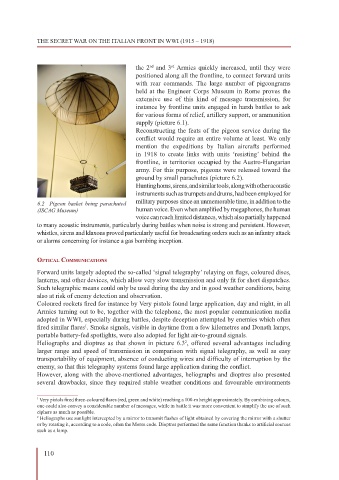
                                                 ground by small parachutes (picture 6.2).
                                                 Hunting horns, sirens, and similar tools, along with other acoustic
                                                 instruments such as trumpets and drums, had been employed for

              6.2    Pigeon  basket  being  parachuted   military purposes since an unmemorable time, in addition to the
              (ISCAG Museum)                     human voice. Even when amplified by megaphones, the human
                                                 voice can reach limited distances, which also partially happened
              to many acoustic instruments, particularly during battles when noise is strong and persistent. However,
              whistles, sirens and klaxons proved particularly useful for broadcasting orders such as an infantry attack
              or alarms concerning for instance a gas bombing inception.


              oPTIcal coMMunIcaTIons

              Forward units largely adopted the so-called ‘signal telegraphy’ relaying on flags, coloured discs,
              lanterns, and other devices, which allow very slow transmission and only fit for short dispatches.
              Such telegraphic means could only be used during the day and in good weather conditions, being
              also at risk of enemy detection and observation.
              Coloured rockets fired for instance by Very pistols found large application, day and night, in all
              Armies turning out to be, together with the telephone, the most popular communication media
              adopted in WWI, especially during battles, despite deception attempted by enemies which often
              fired similar flares . Smoke signals, visible in daytime from a few kilometres and Donath lamps,
                               1
              portable battery-fed spotlights, were also adopted for light air-to-ground signals.
              Heliographs and dioptres as that shown  in picture 6.3 , offered several advantages including
                                                                  2
              larger range and speed of transmission in comparison with signal telegraphy, as well as easy
              transportability of equipment, absence of conducting wires and difficulty of interruption by the
              enemy, so that this telegraphy systems found large application during the conflict.
              However, along with the above-mentioned advantages, heliographs and dioptres also presented
              several drawbacks, since they required stable weather conditions and favourable environments


              1  Very pistols fired three-coloured flares (red, green and white) reaching a 100-m height approximately. By combining colours,
              one could also convey a considerable number of messages, while in battle it was more convenient to simplify the use of such
              ciphers as much as possible.
              2  Heliographs use sunlight intercepted by a mirror to transmit flashes of light obtained by covering the mirror with a shutter
              or by rotating it, according to a code, often the Morse code. Dioptres performed the same function thanks to artificial sources
              such as a lamp.


                110

