


Page 113 - The Secret War in the Italian front in WWI (1915-1918)
P. 113
CHAPTER SIX


                                                      to begin and maintain a connection and moreover, they
                                                      generateted high error occourrence at reception with a not
                                                      perfectly transparent atmosphere or when distance exceeded
                                                      a few kilometres. In fact, it was often necessary to verify the
                                                      transmission accuracy at the end of each word or of each
                                                      group of word, further reducing the transmission speed in
                                                      comparison with that achievable by electrical telegraphy
                                                      transmission. Furthermore, they did not guarantee secrecy
                                                      as generally emit a quite wide beam of light.
                                                      All the media mentioned above had some advantages but
                                                      also serious drawbacks which triggered the success of wire
                                                      telephony and telegraphy, on the Austro-Italian as well as
                                                      on other fronts. On the contrary, the diffusion of wireless
                                                      telegraphy  occurred  slowly  because  of  technical  and
                                                      operating difficulties partially overcome along the conflict
                                                      thanks to a relevant technological advance.


                                                      elecTrIc TelegraPhy and TelePhony

                                                      Telecommunications  on physical conductors - namely
                                                      electrical telegraphy and telephony - had been extensively
                                                      applied by all Armies even before the World War I, as they
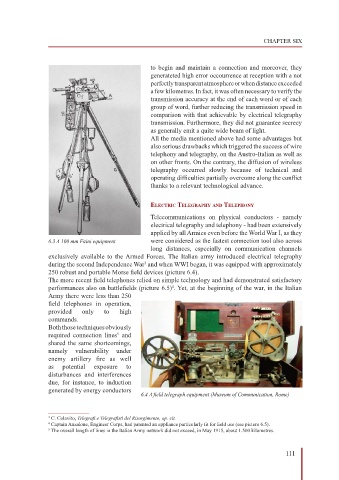
                  6.3 A 100 mm Faini equipment        were considered as the fastest connection tool also across
                                                      long distances,  especially  on communication  channels
                  exclusively  available  to  the Armed  Forces. The  Italian  army  introduced  electrical  telegraphy
                  during the second Independence War  and when WWI began, it was equipped with approximately
                                                    3
                  250 robust and portable Morse field devices (picture 6.4).
                  The more recent field telephones relied on simple technology and had demonstrated satisfactory
                  performances also on battlefields (picture 6.5) . Yet, at the beginning of the war, in the Italian
                                                             4
                  Army there were less than 250
                  field  telephones  in  operation,
                  provided    only    to   high
                  commands.
                  Both those techniques obviously
                  required  connection  lines   and
                                          5
                  shared the same shortcomings,
                  namely  vulnerability  under
                  enemy  artillery  fire  as  well
                  as   potential  exposure   to
                  disturbances  and interferences
                  due, for instance,  to induction
                  generated by energy conductors
                                                   6.4 A field telegraph equipment (Museum of Communication, Rome)


                  3  C. Colavito, Telegrafi e Telegrafisti del Risorgimento, op. cit.
                  4  Captain Anzalone, Engineer Corps, had patented an appliance particularly fit for field use (see picture 6.5).
                  5  The overall length of lines in the Italian Army network did not exceed, in May 1915, about 1.500 kilometres.


                                                                                                     111

