


Page 127 - The Secret War in the Italian front in WWI (1915-1918)
P. 127
CHAPTER SIX


                  When these circumstances do not occur, the code breaking can be implemented by methods that
                  considerably differ from those just described for the literal systems. The level of difficulty usually
                  increases as the codes get bigger and results to be considerably higher for two-part compared to
                  one-part systems. In fact, regarding the one-part codes, once the correspondence between a term in
                  the code and a code group has been discovered, the equivalence with other terms of the following
                  or the previous groups can be quite easy found, by using a dictionary of the language.
                  There are also circumstances that help the solution of any code or cipher, for instance taking
                  advantage of partial coding of massages. Therefore, as a basic rule, ciphering must be integral and
                  comprise all words in the telegram including the address and signature.
                  In addition, the analysts can exploit the operators’ inaccuracy in the coding process. If a codegroup
                  occurs in the same cryptogram several times, its correspondence with frequently used letters or
                  syllables or words may be assumed. In many cases, the use of stereotypical expressions, such as
                  “with reference to your dispatch” or “I am honoured to”, or the knowledge of the topic, the possible
                  structure or even the content of cryptograms help start breaking the code. In fact, once the meaning
                  of some code groups is identified, it can be applied to other enemy cryptograms, which helps to
                  discover more.
                  A further weakness that is often exploited by analysts is the sender’s signature, often encoded letter
                  by letter or syllable by syllable, which makes it easier to decrypt. If the same signature appears in
                  two cryptograms transmitted respectively before and after a change of code or cipher, it helps to
                  start breaking he last if the previous one is known.


                  6.5  MILITARY CRYPTOLOGY


                  encoded coMMunIcaTIons

                  In military telegraphic communication - both wire and radio - as well as, in more simple forms,
                  in the transmission of confidential phonograms, coding and decoding are relevant parts of the
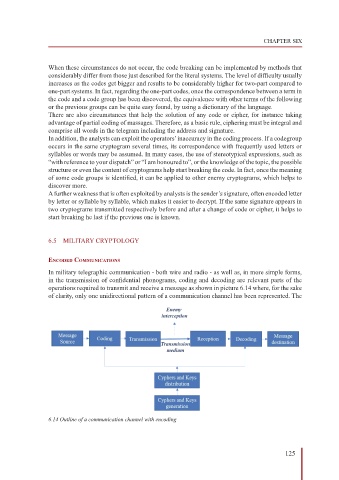
                  operations required to transmit and receive a message as shown in picture 6.14 where, for the sake
                  of clarity, only one unidirectional pattern of a communication channel has been represented. The


                  6.14 Outline of a communication channel with encoding


                                                                                                     125

