


Page 124 - The Secret War in the Italian front in WWI (1915-1918)
P. 124
THE SECRET WAR ON THE ITALIAN FRONT IN WWI (1915 – 1918)


              started to deploy several listening stations,
              each tuned to one of the frequencies most
              often employed by enemy stations.
              An  efficient  method  for  improving
              transmission security became, during the
              war, the  accurate  monitoring  of friendly
              communications  aiming  to avoid  use of
              radio and telephone communications  for
              purposes other than regular service and to
              grant rule compliance on communications
              protection.
              Having explored the limited effectiveness
              of the methods applicable for transmission
              security improvement, let us now analyse
              the characteristics of the last component
              of Communication  Security, namely
              protection of the transmitted dispatches by
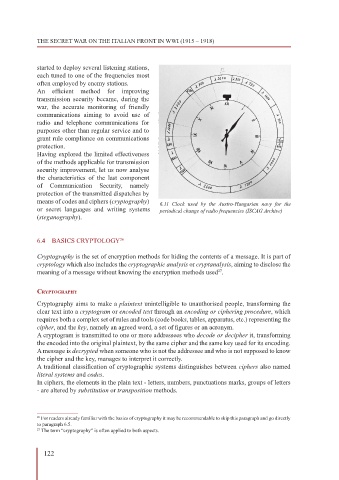
              means of codes and ciphers (cryptography)   6.11  Clock  used  by  the  Austro-Hungarian  navy  for  the
              or secret languages and writing systems    periodical change of radio frequencies (ISCAG Archive)
              (steganography).


              6.4  BASICS CRYPTOLOGY       26

              Cryptography is the set of encryption methods for hiding the contents of a message. It is part of
              cryptology which also includes the cryptographic analysis or cryptanalysis, aiming to disclose the
              meaning of a message without knowing the encryption methods used .
                                                                              27

              cryPTograPhy

              Cryptography aims to make a plaintext unintelligible to unauthorised people, transforming the
              clear text into a cryptogram or encoded text through an encoding or ciphering procedure, which
              requires both a complex set of rules and tools (code books, tables, apparatus, etc.) representing the
              cipher, and the key, namely an agreed word, a set of figures or an acronym.
              A cryptogram is transmitted to one or more addressees who decode or decipher it, transforming
              the encoded into the original plaintext, by the same cipher and the same key used for its encoding.
              A message is decrypted when someone who is not the addressee and who is not supposed to know
              the cipher and the key, manages to interpret it correctly.
              A traditional classification of cryptographic systems distinguishes between ciphers also named
              literal systems and codes.
              In ciphers, the elements in the plain text - letters, numbers, punctuations marks, groups of letters
              - are altered by substitution or transposition methods.


              26  For readers already familiar with the basics of cryptography it may be recommendable to skip this paragraph and go directly
              to paragraph 6.5.
              27  The term “cryptography” is often applied to both aspects.


                122

