


Page 125 - The Secret War in the Italian front in WWI (1915-1918)
P. 125
CHAPTER SIX


                                                                          In   substitution  methods,   the
                                                                          plaintext  elements are  replaced  by
                                                                          another conventional sign. The most
                                                                          famous and ancient among them is
                                                                          the  Caesar  cipher, where alphabet
                                                                          letters are replaced by letters of the
                                                                          same  alphabet  shifted  by  a  fixed
                                                                          interval (A is replaced by C and B
                                                                          by D, etc.).  Those simple  mono-
                                                                          alphabetic  ciphers  were  mostly
                                                                          substituted,  as  far  back  as  the  15
                                                                                                          th
                                                                          century, by poly-alphabetic systems
                                                                          where replacing  alphabets  are
                                                                          numerous and chosen, for each letter
                                                                          or group of letters  of the original
                                                                          message, according to a numerical or
                                                                          alphabetic key. The first application
                                                                          of a poly-alphabetical code is Leon
                                                                          Battista Alberti’s ciphering disc and
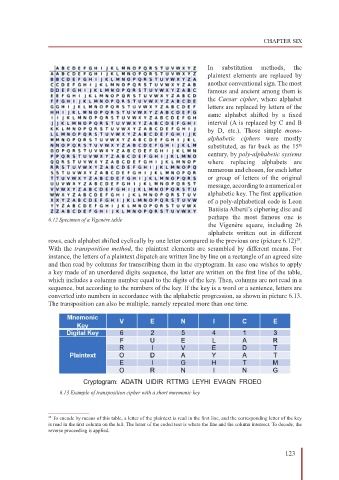
                  6.12 Specimen of a Vigenère table                       perhaps the most famous one is
                                                                          the  Vigenère  square, including  26
                                                                          alphabets  written  out in different
                  rows, each alphabet shifted cyclically by one letter compared to the previous one (picture 6.12) .
                                                                                                         28
                  With  the  transposition  method, the  plaintext  elements  are scrambled  by different  means. For
                  instance, the letters of a plaintext dispatch are written line by line on a rectangle of an agreed size
                  and then read by columns for transcribing them in the cryptogram. In case one wishes to apply
                  a key made of an unordered digits sequence, the latter are written on the first line of the table,
                  which includes a columns number equal to the digits of the key. Then, columns are not read in a
                  sequence, but according to the numbers of the key. If the key is a word or a sentence, letters are
                  converted into numbers in accordance with the alphabetic progression, as shown in picture 6.13.
                  The transposition can also be multiple, namely repeated more than one time.


                      6.13 Example of transposition cipher with a short mnemonic key


                  28  To encode by means of this table, a letter of the plaintext is read in the first line, and the corresponding letter of the key
                  is read in the first column on the left. The letter of the coded text is where the line and the column intersect. To decode, the
                  reverse proceeding is applied.


                                                                                                     123

