


Page 123 - The Secret War in the Italian front in WWI (1915-1918)
P. 123
CHAPTER SIX


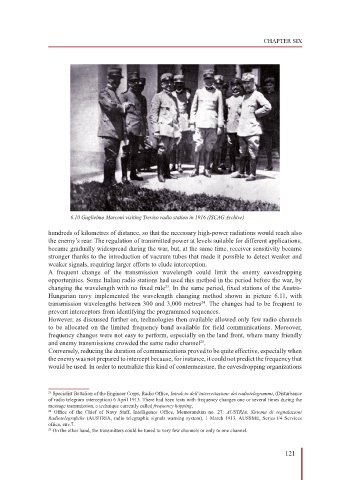
                          6.10 Guglielmo Marconi visiting Treviso radio station in 1916 (ISCAG Archive)

                  hundreds of kilometres of distance, so that the necessary high-power radiations would reach also
                  the enemy’s rear. The regulation of transmitted power at levels suitable for different applications,
                  became gradually widespread during the war, but, at the same time, receiver sensitivity became
                  stronger thanks to the introduction of vacuum tubes that made it possible to detect weaker and
                  weaker signals, requiring larger efforts to elude interception.
                  A  frequent  change  of the transmission  wavelength  could  limit  the  enemy  eavesdropping
                  opportunities. Some Italian radio stations had used this method in the period before the war, by
                  changing the wavelength with no fixed rule . In the same period, fixed stations of the Austro-
                                                           23
                  Hungarian  navy  implemented  the  wavelength  changing  method  shown in  picture  6.11,  with
                  transmission wavelengths between 300 and 3,000 metres . The changes had to be frequent to
                                                                        24
                  prevent interceptors from identifying the programmed sequences.
                  However, as discussed further on, technologies then available allowed only few radio channels
                  to  be  allocated  on  the  limited  frequency  band  available  for  field  communications. Moreover,
                  frequency changes were not easy to perform, especially on the land front, where many friendly
                  and enemy transmissions crowded the same radio channel .
                                                                       25
                  Conversely, reducing the duration of communications proved to be quite effective, especially when
                  the enemy was not prepared to intercept because, for instance, it could not predict the frequency that
                  would be used. In order to neutralize this kind of contermeasure, the eavesdropping organizations


                  23  Specialist Battalion of the Engineer Corps, Radio Office, Intralcio dell’intercettazione dei radiotelegrammi, (Disturbance
                  of radio telegram interception) 6 April 1913. There had been tests with frequency changes one or several times during the
                  message transmission, a technique currently called frequency hopping,
                  24   Office  of  the  Chief  of  Navy  Staff,  Intelligence  Office,  Memorandum  no.  27:  AUSTRIA,  Sistema  di  segnalazioni
                  Radiotelegrafiche (AUSTRIA, radio telegraphic signals warning system), 1 March 1913, AUSSME, Series F4 Services
                  office, env.7.
                  25  On the other hand, the transmitters could be tuned to very few channels or only to one channel.


                                                                                                     121

