


Page 134 - The Secret War in the Italian front in WWI (1915-1918)
P. 134
THE SECRET WAR ON THE ITALIAN FRONT IN WWI (1915 – 1918)


              requirements and employ them during the army manoeuvres from 1905 to 1907. The objective was to
              “cover” increasingly longer distances - up to more than 100 km - on hilly or even mountainous terrains .
                                                                                                      3
              However, the relations between the Army and Marconi Wireless’s representative in Rome, Marquis Luigi
              Solari, were not always idyllic, also because the latter claimed exclusive rights for his own company
              regarding the equipment supplies. A whole volume would be necessary to recount the numerous
              misunderstandings between Solari and the technicians of the Army concerning, for instance, the 1908
              tests on equipment to be used by the Cavalry . Other disagreements arose at the end of 1909, when the
                                                     4
              Army stations to be included in the ‘National fixed network’ were set up by using equipment provided
              by the company Jacoviello, since the Marconi Wireless had not provided the required devices within the
              very tight deadlines imposed by the urgent necessity to prepare radiotelegraphic connections between
              major Italian cities, in light of the strike of the Ministry of Post and Telegraphs’ employees.


              The lIbyan war
              Tension between Marquis Solari and the Army Headquarters peaked two years later when, to deal with
              an emergency during the war in Libya, 300 W radio telegraphic systems made by the French company
              SFR were installed in Cyrenaica and in the Aegean islands, instead of the 500 W Marconi stations which
              did not perform satisfactorily, above all due to engine overheating caused by the Libyan climate .
                                                                                                 5


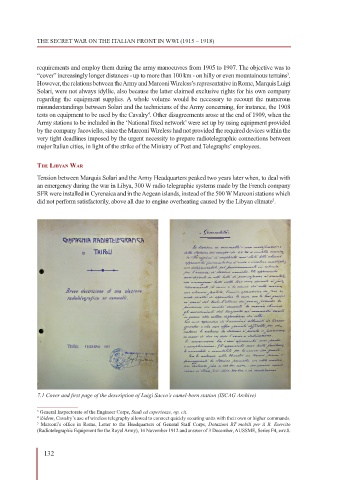
              7.1 Cover and first page of the description of Luigi Sacco’s camel-born station (ISCAG Archive)


              3  General Inspectorate of the Engineer Corps, Studi ed esperienze, op. cit.
              4  ibidem, Cavalry’s use of wireless telegraphy allowed to connect quickly scouting units with their own or higher commands.
              5   Marconi’s  office  in  Rome,  Letter  to  the  Headquarters  of  General  Staff  Corps,  Dotazioni  RT  mobili  per  il  R.  Esercito
              (Radiotelegraphic Equipment for the Royal Army), 14 November 1912 and answer of 3 December, AUSSME, Series F4, env.8.


                132

