


Page 167 - The Secret War in the Italian front in WWI (1915-1918)
P. 167
CHAPTER EIGHT


                                                                         The Information gathering was possible
                                                                         thanks to the military agreement
                                                                         between Italy and the Entente’s Allies
                                                                         that  envisaged “close  cooperation
                                                                         between staff of allied armed forces
                                                                         through special missions of liaison
                                                                         officers” . Sacco could rely on the
                                                                                43
                                                                         Military Mission established in France
                                                                         on 25 May 1915 and led by Colonel
                                                                         Giovanni Breganze.
                                                                         On coming back to Italy in early August,
                                                                         Sacco delivered a report summing up the
                                                                         collected information not limited to the
                                                                         cryptographic issue, but regarding the
                                                                         existing situation on the western front line
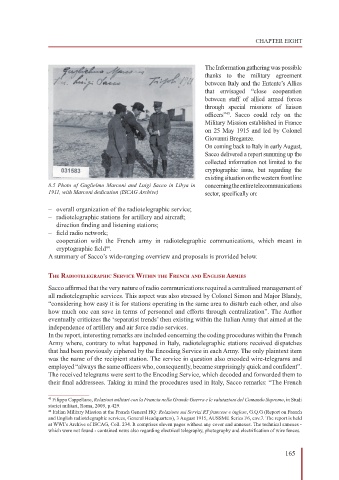
                  8.5 Photo of Guglielmo Marconi and Luigi Sacco in Libya in   concerning the entire telecommunications
                  1911, with Marconi dedication (ISCAG Archive)          sector, specifically on:


                     – overall organization of the radiotelegraphic service;
                     – radiotelegraphic stations for artillery and aircraft;
                     – direction finding and listening stations;
                     – field radio network;
                     – cooperation  with the French army in radiotelegraphic  communications,  which meant  in
                     cryptographic field .
                                      44
                  A summary of Sacco’s wide-ranging overview and proposals is provided below.


                  The radIoTelegraPhIc servIce wIThIn The french and englIsh arMIes
                  Sacco affirmed that the very nature of radio communications required a centralised management of
                  all radiotelegraphic services. This aspect was also stressed by Colonel Simon and Major Blandy,
                  “considering how easy it is for stations operating in the same area to disturb each other, and also
                  how much one can save in terms of personnel and efforts through centralization”. The Author
                  eventually criticizes the ‘separatist trends’ then existing within the Italian Army that aimed at the
                  independence of artillery and air force radio services.
                  In the report, interesting remarks are included concerning the coding procedures within the French
                  Army where, contrary to what happened in Italy, radiotelegraphic stations received dispatches
                  that had been previously ciphered by the Encoding Service in each Army. The only plaintext item
                  was the name of the recipient station. The service in question also encoded wire-telegrams and
                  employed “always the same officers who, consequently, became surprisingly quick and confident”.
                  The received telegrams were sent to the Encoding Service, which decoded and forwarded them to
                  their final addressees. Taking in mind the procedures used in Italy, Sacco remarks: “The French


                  43  Filippo Cappellano, Relazioni militari con la Francia nella Grande Guerra e le valutazioni del Comando Supremo, in Studi
                  storici militari, Roma, 2009, p.429.
                  44  Italian Military Mission at the French General HQ: Relazione sui Servizi RT francese e inglese, G.Q.G (Report on French
                  and English radiotelegraphic services, General Headquarters), 3 August 1915, AUSSME Series F6, env.7. The report is held
                  at WWI’s Archive of ISCAG, Coll. 234. It comprises eleven pages without any cover and annexes. The technical annexes -
                  which were not found - contained news also regarding electrical telegraphy, photography and electrification of wire fences.


                                                                                                     165

