


Page 168 - The Secret War in the Italian front in WWI (1915-1918)
P. 168
THE SECRET WAR ON THE ITALIAN FRONT IN WWI (1915 – 1918)


              organization, based on the division of tasks, considerably simplifies the work of radiotelegraphic
              personnel, with remarkable benefits in terms of secrecy of communications”.


              InTercePTIon and decryPTIon
              Listening stations of  Allied armies, located
              in several areas along the front, immediately
              transmitted  to their  Headquarters  the
              intercepted dispatches via wire telegraph in the
              French army and via telephone in the English
              one.
              The  French  General  Headquarters  identified
              enemy transmitters and decrypted dispatches
              using already  known ciphers.  The most
              ‘difficult’  cryptograms  were  sent  to  the
              Ministry  of  War  in  Paris where  “Colonel
              Le  Cartier  leads  the  office  that  has  already
              managed to identify the keys of German radio
              communications” . Sacco reports that the
                              45
              results  obtained  had  effectively  supported
              the French army operations during the early
              phases of the war, but in July 1915 the number
              of German radio transmission had decreased
              considerably due to the stabilized position of
              armies on the western front.
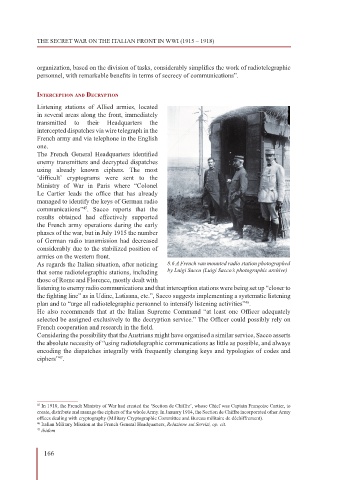
              As regards the Italian situation, after noticing   8.6 A French van mounted radio station photographed
              that some radiotelegraphic stations, including   by Luigi Sacco (Luigi Sacco’s photographic archive)
              those of Rome and Florence, mostly dealt with
              listening to enemy radio communications and that interception stations were being set up “closer to
              the fighting line” as in Udine, Latisana, etc.”, Sacco suggests implementing a systematic listening
              plan and to “urge all radiotelegraphic personnel to intensify listening activities” .
                                                                                       46
              He  also  recommends  that  at  the  Italian  Supreme  Command  “at  least  one  Officer  adequately
              selected be assigned exclusively to the decryption service.” The Officer could possibly rely on
              French cooperation and research in the field.
              Considering the possibility that the Austrians might have organised a similar service, Sacco asserts
              the absolute necessity of “using radiotelegraphic communications as little as possible, and always
              encoding the dispatches integrally with frequently changing keys and typologies of codes and
              ciphers” .
                      47


              45  In 1910, the French Ministry of War had created the ‘Section de Chiffre’, whose Chief was Captain Françoise Cartier, to
              create, distribute and manage the ciphers of the whole Army. In January 1914, the Section de Chiffre incorporated other Army
              offices dealing with cryptography (Military Cryptographic Committee and Bureau militaire de déchiffrement).
              46  Italian Military Mission at the French General Headquarters, Relazione sui Servizi, op. cit.
              47  ibidem


                166

