


Page 169 - The Secret War in the Italian front in WWI (1915-1918)
P. 169
CHAPTER EIGHT


                  radIogonIoMeTry
                  After visiting a French station
                  in Joncheriy  and a British
                  one in Quiestede, Sacco
                  declared to be ready to apply
                  radiogoniometry on the Italian
                  front, as “two direction finding
                  equipment    were    already
                  available,  and it  is relatively
                  easy  to build some  others
                  (in case there are no off-the-
                  shelf ones)”.  Therefore, it
                  was  possible to immediately
                  start a radio direction finding
                  service with 4 stations, two -
                  Mantua and Ancona - designed
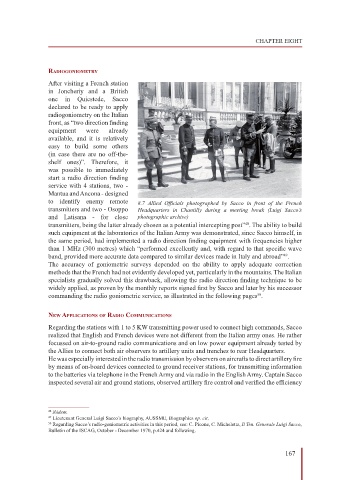
                  to identify  enemy  remote     8.7  Allied  Officials  photographed  by  Sacco  in  front  of  the  French
                  transmitters and two - Osoppo   Headquarters  in  Chantilly  during  a  meeting  break  (Luigi  Sacco’s
                  and Latisana - for close       photographic archive)
                  transmitters, being the latter already chosen as a potential intercepting post” . The ability to build
                                                                                       48
                  such equipment at the laboratories of the Italian Army was demonstrated, since Sacco himself, in
                  the same period, had implemented a radio direction finding equipment with frequencies higher
                  than 1 MHz (300 metres) which “performed excellently and, with regard to that specific wave
                  band, provided more accurate data compared to similar devices made in Italy and abroad” .
                                                                                                     49
                  The  accuracy  of  goniometric  surveys depended  on  the  ability  to  apply  adequate  correction
                  methods that the French had not evidently developed yet, particularly in the mountains. The Italian
                  specialists gradually solved this drawback, allowing the radio direction finding technique to be
                  widely applied, as proven by the monthly reports signed first by Sacco and later by his successor
                  commanding the radio goniometric service, as illustrated in the following pages .
                                                                                           50

                  new aPPlIcaTIons of radIo coMMunIcaTIons

                  Regarding the stations with 1 to 5 KW transmitting power used to connect high commands, Sacco
                  realized that English and French devices were not different from the Italian army ones. He rather
                  focussed on air-to-ground radio communications and on low power equipment already tested by
                  the Allies to connect both air observers to artillery units and trenches to rear Headquarters.
                  He was especially interested in the radio transmission by observers on aircrafts to direct artillery fire
                  by means of on-board devices connected to ground receiver stations, for transmitting information
                  to the batteries via telephone in the French Army and via radio in the English Army. Captain Sacco
                  inspected several air and ground stations, observed artillery fire control and verified the efficiency


                  48  ibidem.
                  49  Lieutenant General Luigi Sacco’s biography, AUSSME, Biographies op. cit.
                  50  Regarding Sacco’s radio-goniometric activities in this period, see: C. Picone, C. Micheletta, Il Ten. Generale Luigi Sacco,
                  Bulletin of the ISCAG, October - December 1970, p.424 and following.


                                                                                                     167

