


Page 174 - The Secret War in the Italian front in WWI (1915-1918)
P. 174
THE SECRET WAR ON THE ITALIAN FRONT IN WWI (1915 – 1918)


                 – the supply from France of 300Watt stations;
                 – the transfer to the 1  Army by mid-October of some 500Watt stations (picture 8.8) available at
                                   st
                 the Airship Battalion .
                                    67
              By the end of the year, there were slightly more than thirty stations , operating in the war zone,
                                                                            68
              excluding the units used for interception, direction finding and air force service. 50Watt stations
              appeared immediately thereafter.


              The fIrsT aIr-To-ground coMMunIcaTIons
              The purchase from S.F.R. and few weeks later also from Marconi Wireless of the first on-board
              transmitters and ground receiving
              stations  made  it  possible  to test,
              as of August 1915, an assistance
              service for artillery fire control by
              means of unidirectional telegraphic
              air-to-ground     connections .
                                           69
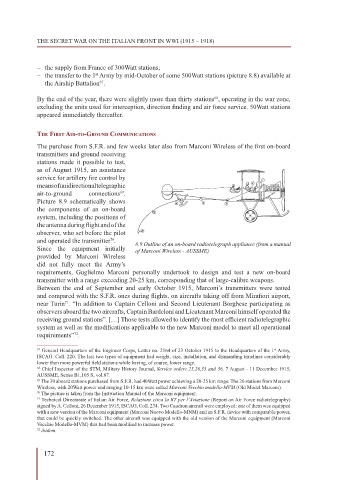
              Picture  8.9 schematically  shows
              the components of an on-board
              system, including the positions of
              the antenna during flight and of the
              observer, who set before the pilot
              and operated the transmitter .     8.9 Outline of an on-board radiotelegraph appliance (from a manual
                                        70
              Since the equipment  initially     of Marconi Wireless - AUSSME)
              provided by Marconi  Wireless
              did not fully meet  the  Army’s
              requirements,  Guglielmo  Marconi personally undertook to design and test a new on-board
              transmitter with a range exceeding 20-25 km, corresponding that of large-calibre weapons.
              Between the end of September and early October 1915, Marconi’s transmitters  were tested
              and compared with the S.F.R. ones during flights, on aircrafts taking off from Mirafiori airport,
              near Turin . “In addition to Captain Celloni and Second Lieutenant Borghese participating as
                        71
              observers aboard the two aircrafts, Captain Bardeloni and Lieutenant Marconi himself operated the
              receiving ground stations”. […] Those tests allowed to identify the most efficient radiotelegraphic
              system as well as the modifications applicable to the new Marconi model to meet all operational
              requirements” .
                           72

              67  General Headquarters of the Engineer Corps, Letter no. 2164 of 23 October 1915 to the Headquarters of the 1  Army,
                                                                                                 st
              ISCAG. Coll. 220. The last two types of equipment had weight, size, installation, and dismantling timelines considerably
              lower than more powerful field stations while having, of course, lower range.
              68  Chief Inspector of the STM, Military History Journal, Service orders 25,26,33 and 36, 7 August - 11 December 1915,
              AUSSME, Series B1,105 S, vol.87.
              69  The 30 aboard stations purchased from S.F.R. had 40Watt power achieving a 20-25 km range. The 20 stations from Marconi
              Wireless, with 20Watt power and ranging 10-15 km were called Marconi Vecchio modello-MVM (Old Model Marconi).
              70  The picture is taken from the Instruction Manual of the Marconi equipment.
              71  Technical Directorate of Italian Air Force, Relazione circa la RT per l’Aviazione (Report on Air Force radiotelegraphy)
              signed by A. Celloni, 26 December 1915, ISCAG, Coll. 234. Two Caudron aircraft were employed: one of them was equipped
              with a new version of the Marconi equipment (Marconi Nuovo Modello-MNM) and an S.F.R. device with comparable power,
              that could be quickly switched. The other aircraft was equipped with the old version of the Marconi equipment (Marconi
              Vecchio Modello-MVM) that had been modified to increase power.
              72  ibidem.


                172

