


Page 175 - The Secret War in the Italian front in WWI (1915-1918)
P. 175
CHAPTER EIGHT


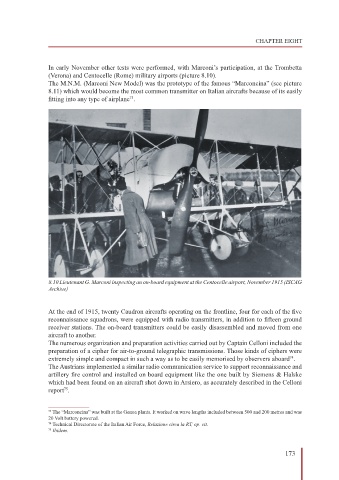
                  In early November other tests were performed, with Marconi’s participation, at the Trombetta
                  (Verona) and Centocelle (Rome) military airports (picture 8.10).
                  The M.N.M. (Marconi New Model) was the prototype of the famous “Marconcina” (see picture
                  8.11) which would become the most common transmitter on Italian aircrafts because of its easily
                  fitting into any type of airplane .
                                               73


                  8.10 Lieutenant G. Marconi inspecting an on-board equipment at the Centocelle airport, November 1915 (ISCAG
                  Archive)


                  At the end of 1915, twenty Caudron aircrafts operating on the frontline, four for each of the five
                  reconnaissance squadrons, were equipped with radio transmitters, in addition to fifteen ground
                  receiver stations. The on-board transmitters could be easily disassembled and moved from one
                  aircraft to another.
                  The numerous organization and preparation activities carried out by Captain Celloni included the
                  preparation of a cipher for air-to-ground telegraphic transmissions. Those kinds of ciphers were
                  extremely simple and compact in such a way as to be easily memorised by observers aboard .
                                                                                                       74
                  The Austrians implemented a similar radio communication service to support reconnaissance and
                  artillery fire control and installed on board equipment like the one built by Siemens & Halske
                  which had been found on an aircraft shot down in Arsiero, as accurately described in the Celloni
                  report .
                       75


                  73  The “Marconcina” was built at the Genoa plants. It worked on wave lengths included between 500 and 200 metres and was
                  20 Volt battery powered.
                  74  Technical Directorate of the Italian Air Force, Relazione circa la RT, op. cit.
                  75  Ibidem.


                                                                                                     173

