


Page 180 - The Secret War in the Italian front in WWI (1915-1918)
P. 180
THE SECRET WAR ON THE ITALIAN FRONT IN WWI (1915 – 1918)


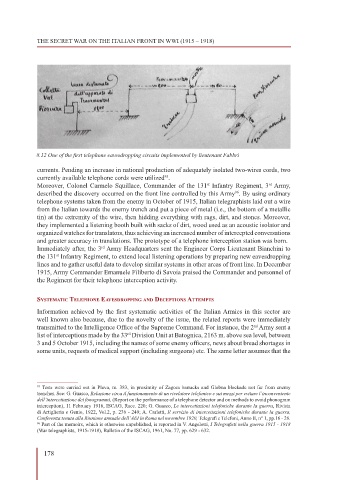
              8.12 One of the first telephone eavesdropping circuits implemented by lieutenant Fabbri

              currents. Pending an increase in national production of adequately isolated two-wires cords, two
              currently available telephone cords were utilized .
                                                           95
              Moreover, Colonel Carmelo Squillace, Commander of the 131  Infantry Regiment, 3  Army,
                                                                                               rd
                                                                          st
              described the discovery occurred on the front line controlled by this Army . By using ordinary
                                                                                    96
              telephone systems taken from the enemy in October of 1915, Italian telegraphists laid out a wire
              from the Italian towards the enemy trench and put a piece of metal (i.e., the bottom of a metallic
              tin) at the extremity of the wire, then hidding everything with rags, dirt, and stones. Moreover,
              they implemented a listening booth built with sacks of dirt, wood used as an acoustic isolator and
              organized watches for translators, thus achieving an increased number of intercepted conversations
              and greater accuracy in translations. The prototype of a telephone interception station was born.
              Immediately after, the 3  Army Headquarters sent the Engineer Corps Lieutenant Bianchini to
                                     rd
              the 131  Infantry Regiment, to extend local listening operations by preparing new eavesdropping
                     st
              lines and to gather useful data to develop similar systems in other areas of front line. In December
              1915, Army Commander Emanuele Filiberto di Savoia praised the Commander and personnel of
              the Regiment for their telephone interception activity.


              sysTeMaTIc TelePhone eavesdroPPIng and decePTIons aTTeMPTs
              Information achieved by the first systematic activities of the Italian Armies in this sector are
              well known also because, due to the novelty of the issue, the related reports were immediately
              transmitted to the Intelligence Office of the Supreme Command. For instance, the 2  Army sent a
                                                                                          nd
              list of interceptions made by the 33  Division Unit at Batognica, 2163 m. above sea level, between
                                              rd
              3 and 5 October 1915, including the names of some enemy officers, news about bread shortages in
              some units, requests of medical support (including surgeons) etc. The same letter assumes that the


              95  Tests were  carried  out  in  Plava, m.  383, in  proximity  of Zagora  barracks  and  Globna  blockade  not  far  from  enemy
              trenches. See: G. Guasco, Relazione circa il funzionamento di un rivelatore telefonico e sui mezzi per evitare l’inconveniente
              dell’intercettazione dei fonogrammi, (Report on the performance of a telephone detector and on methods to avoid phonogram
              interception), 11 February 1916, ISCAG, Racc. 220; G. Guasco, Le intercettazioni telefoniche durante la guerra, Rivista
              di Artiglieria e Genio, 1922, Vol.2, p. 236 - 249; A. Carletti, Il servizio di intercettazioni telefoniche durante la guerra,
              Conferenza tenuta alla Riunione annuale dell’AEI in Roma nel novembre 1920, Telegrafi e Telefoni, Anno II, n° 1, pp.16 - 26.
              96  Part of the memoirs, which is otherwise unpublished, is reported in V. Angelotti, I Telegrafisti nella guerra 1915 - 1918
              (War telegraphists, 1915-1918), Bulletin of the ISCAG, 1961, No. 77, pp. 629 - 632.


                178

