


Page 173 - The Secret War in the Italian front in WWI (1915-1918)
P. 173
CHAPTER EIGHT


                  Following the disappointing outcome of the agreement with the Allies, and in compliance with
                  assigned tasks, Sacco tried to interpret intercepted enemy dispatches on his own. O. Marchetti
                  explains: “we had no enemy code or chipher, it had not been possible to get them during peacetime
                  and nobody considered it useful to request their research to our agents. […] However, an Engineer
                  Corps Lieutenant, despite he had no knowledge of the German language, proved to be so brilliant
                  in his reasoning and deductions that, with the help of other officers, he managed to get some
                  plaintext fragments of intercepted encoded messages” .
                                                                    64
                  Sacco’s efforts in cryptanalysis remained solitary throughout 1915. He did not get any help he
                  relieved of the burden to manage the development and operation of the radio network implemented
                  for carrying out interception and goniometric measurements.


                  8.5  ITALIAN RADIO OVER THE FIRST SIX MONTHS OF WAR


                  evoluTIon of radIoTelegraPhy aPPlIcaTIons
                  Since the early months of war, the Italian Army realized the need of a more extensive radio usage,
                  including  new applications,  such as “air-to-ground  communications  and  fast warnings about
                  enemy aircrafts approaching” .
                                             65
                  Radio communications  between
                  ground locations  were specially
                  wanted in emergencies, when
                  bad weather  interrupted  physical
                  connections,  or during artillery
                  fire   systematically   destroying
                  wire connections that  could not
                  be  quickly  restored.  Moreover,
                  locations in the mountains, difficult
                  to  be  reached  via  physical  lines,
                  could be connected only by radio.
                  The  demand of new radio
                  links  conflicted  with  “limited
                  availability  of equipment  along
                  with the difficulty obtaining them
                  from Italian  industry”. Therefore,
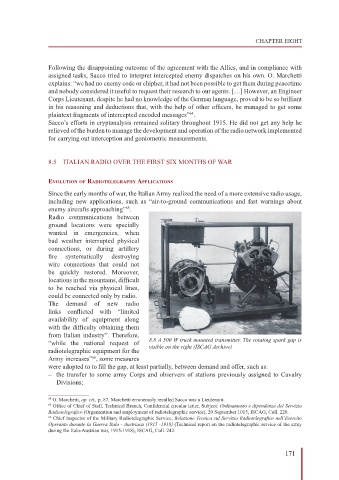
                  “while  the  national  request of   8.8 A 500 W truck mounted transmitter. The rotating spark gap is
                                                     visible on the right (ISCAG Archive)
                  radiotelegraphic equipment for the
                  Army increases” , some measures
                                 66
                  were adopted to to fill the gap, at least partially, between demand and offer, such as:
                     – the transfer to some army Corps and observers of stations previously assigned to Cavalry
                     Divisions;


                  64  O. Marchetti, op. cit., p. 87. Marchetti erroneously recalled Sacco was a Lieutenant.
                  65  Office of Chief of Staff, Technical Branch, Confidential circular letter, Subject: Ordinamento e dipendenza del Servizio
                  Radiotelegrafico (Organization and employment of radiotelegraphic service), 20 September 1015, ISCAG, Coll. 220.
                  66  Chief Inspector of the Military Radiotelegraphic Service, Relazione Tecnica sul Servizio Radiotelegrafico nell’Esercito
                  Operante durante la Guerra Italo - Austriaca (1915 -1918) (Technical report on the radiotelegraphic service of the army
                  during the Italo-Austrian war, 1915-1918), ISCAG, Coll. 242.


                                                                                                     171

