


Page 246 - The Secret War in the Italian front in WWI (1915-1918)
P. 246
THE SECRET WAR ON THE ITALIAN FRONT IN WWI (1915 – 1918)


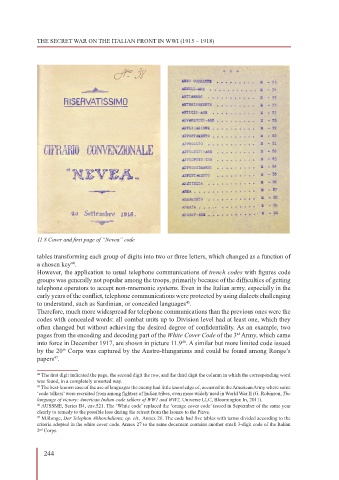
              11.8 Cover and first page of “Nevea” code

              tables transforming each group of digits into two or three letters, which changed as a function of
              a chosen key .
                          44
              However, the application to usual telephone communications of trench codes with figures code
              groups was generally not popular among the troops, primarily because of the difficulties of getting
              telephone operators to accept non-mnemonic systems. Even in the Italian army, especially in the
              early years of the conflict, telephone communications were protected by using dialects challenging
              to understand, such as Sardinian, or concealed languages .
                                                                  45
              Therefore, much more widespread for telephone communications than the previous ones were the
              codes with concealed words: all combat units up to Division level had at least one, which they
              often changed but without achieving the desired degree of confidentiality. As an example, two
              pages from the encoding and decoding part of the White Cover Code of the 3  Army, which came
                                                                                    rd
              into force in December 1917, are shown in picture 11.9 . A similar but more limited code issued
                                                                 46
              by the 20  Corps was captured by the Austro-Hungarians and could be found among Ronge’s
                       th
              papers .
                    47

              44  The first digit indicated the page, the second digit the row, and the third digit the column in which the corresponding word
              was found, in a completely unsorted way.
              45  The best-known case of the use of languages the enemy had little knowledge of, occurred in the American Army where some
              ‘code talkers’ were recruited from among fighters of Indian tribes, even more widely used in World War II (G. Robinson, The
              language of victory: American Indian code talkers of WW1 and WW2, Universe LLC, Bloomington In, 2011).
              46  AUSSME, Series B4, env.521. The ‘White code’ replaced the ‘orange cover code’ issued in September of the same year
              clearly to remedy to the possible loss during the retreat from the Isonzo to the Piave.
              47  M.Ronge, Der Telephon Abhorchdienst, op. cit., Annex 26. The code had five tables with terms divided according to the
              criteria adopted in the white cover code. Annex 27 to the same document contains another small 3-digit code of the Italian
               nd
              2  Corps.

                244

