


Page 242 - The Secret War in the Italian front in WWI (1915-1918)
P. 242
THE SECRET WAR ON THE ITALIAN FRONT IN WWI (1915 – 1918)


              Small radio stations with even
              lower transmitted power became
              needful for connecting isolated and
              difficult  to  reach  positions,  such
              as observers in the mountains .
                                             29
              A record in this respect was the
              installation and activation of a radio
              station  at the Rifugio Garibaldi
              (Dreisprachenspitze) in the Stelvio
              Park, 2,845 metres above sea level,
              by the Telegraphic Section of the1
                                              st
              Army.
              The spreading of radio equipment
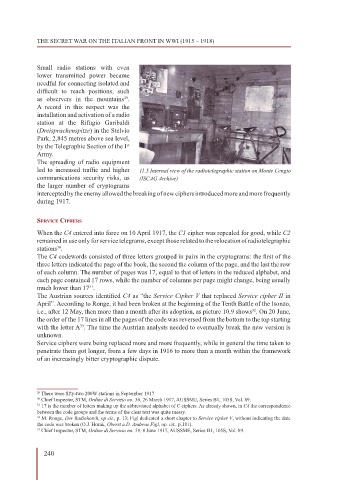
              led to increased traffic and higher   11.5 Internal view of the radiotelegraphic station on Monte Cengio
              communications  security risks, as   (ISCAG Archive)
              the larger number of cryptograms
              intercepted by the enemy allowed the breaking of new ciphers introduced more and more frequently
              during 1917.


              servIce cIPhers
              When the C4 entered into force on 10 April 1917, the C1 cipher was repealed for good, while C2
              remained in use only for service telegrams, except those related to the relocation of radiotelegraphic
              stations .
                     30
              The C4 codewords consisted of three letters grouped in pairs in the cryptograms: the first of the
              three letters indicated the page of the book, the second the column of the page, and the last the row
              of each column. The number of pages was 17, equal to that of letters in the reduced alphabet, and
              each page contained 17 rows, while the number of columns per page might change, being usually
              much lower than 17 .
                                31
              The Austrian sources identified C4 as “the Service Cipher V that replaced Service cipher II in
              April”. According to Ronge, it had been broken at the beginning of the Tenth Battle of the Isonzo,
              i.e., after 12 May, then more than a month after its adoption, as picture 10.9 shows . On 20 June,
                                                                                          32
              the order of the 17 lines in all the pages of the code was reversed from the bottom to the top starting
              with the letter A . The time the Austrian analysts needed to eventually break the new version is
                             33
              unknown.
              Service ciphers were being replaced more and more frequently, while in general the time taken to
              penetrate them got longer, from a few days in 1916 to more than a month within the framework
              of an increasingly bitter cryptographic dispute.


              29  There were fifty-two 200W stations in September 1917.
              30  Chief Inspector, STM, Ordine di Servizio no. 56, 26 March 1917, AUSSME, Series B1, 105S, Vol. 89.
              31  17 is the number of letters making up the abbreviated alphabet of C ciphers. As already shown, in C4 the correspondence
              between the code groups and the terms of the clear text was quite messy.
              32  M. Ronge, Der Radiohorch, op cit., p. 13; Figl dedicated a short chapter to Service cipher V, without indicating the date
              the code was broken (O.J. Horak, Oberst a.D. Andreas Figl, op. cit., p.181).
              33  Chief Inspector, STM, Ordine di Servizio no. 59, 8 June 1917, AUSSME, Series B1, 105S, Vol. 89.


                240

