


Page 237 - The Secret War in the Italian front in WWI (1915-1918)
P. 237
CHAPTER ELEVEN


                  and receiving stations carrying out mainly interception activities, which increased to thirteen in
                  October .
                         17
                  The radiotelegraphic detachment continued to grow in importance and size, and in September
                  1917 it was renamed ‘1  Direction Radio goniometric Section’ under the direct authority of the
                                        st
                  Inspector of the Military Telegraphic Service .
                                                           18
                  From the bi-monthly reports of the Detachment/Section, one can understand the relevance of the
                  activity it carried out. The enemy stations were grouped based on nationality, wavelength, etc. in
                  a manner even more detailed than in the previous year, specifying for each of them, the name,
                  the stations it was linked to, the type and frequency of contacts, the technical characteristics, and
                  especially the type of ciphers used .
                                                  19
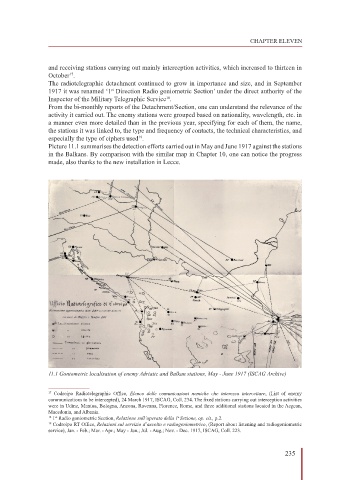
                  Picture 11.1 summarises the detection efforts carried out in May and June 1917 against the stations
                  in the Balkans. By comparison with the similar map in Chapter 10, one can notice the progress
                  made, also thanks to the new installation in Lecce.


                  11.1 Goniometric localisation of enemy Adriatic and Balkan stations, May - June 1917 (ISCAG Archive)


                  17   Codroipo  Radiotelegraphic  Office,  Elenco  delle  comunicazioni  nemiche  che  interessa  intercettare, (List of enemy
                  communications to be intercepted), 24 March 1917, ISCAG, Coll. 234. The fixed stations carrying out interception activities
                  were in Udine, Mantua, Bologna, Ancona, Ravenna, Florence, Rome, and three additional stations located in the Aegean,
                  Macedonia, and Albania.
                                                                a
                    st
                  18  1  Radio goniometric Section, Relazione sull’operato della 1 Sezione, op. cit., p.2.
                  19  Codroipo RT Office, Relazioni sul servizio d’ascolto e radiogoniometrico, (Report about listening and radiogoniometric
                  service), Jan. - Feb.; Mar. - Apr.; May - Jun.; Jul. - Aug.; Nov. - Dec. 1917, ISCAG, Coll. 223.

                                                                                                     235

