


Page 240 - The Secret War in the Italian front in WWI (1915-1918)
P. 240
THE SECRET WAR ON THE ITALIAN FRONT IN WWI (1915 – 1918)


              In April 1917, for instance, the  three-letter  radio  call-signs of the  German  submarines  were
              identified, of which the first two indicated the fleet they belonged to and the last the unit: “The
              ‘FQ’ two-letter group was the ‘submarine fleet call’. The names of the FQ fleet units heard in April
              in the Mediterranean were as follows: FQC (9 April); FQWH (9 April), etc.” .
                                                                                    23
              Goniometric  triangulations, even triple or quadruple, were repeated  several times to identify
              the routes and activities of several units of the German and Austrian submarine fleet . Among
                                                                                              24
              other results, the surveys supported the assumption concerning the presence of “submarines that
              transported torpedoes and ammunition between Pula or Kotor and the Western Mediterranean
              where they are believed to resupply the submarines that operate in the Atlantic” .
                                                                                       25
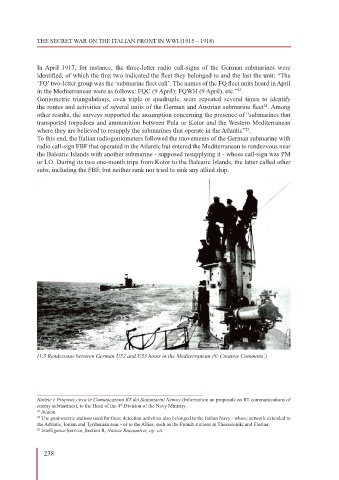
              To this end, the Italian radiogoniometers followed the movements of the German submarine with
              radio call-sign FBF that operated in the Atlantic but entered the Mediterranean to rendezvous near
              the Balearic Islands with another submarine - supposed resupplying it - whose call-sign was PM
              or LO. During its two one-month trips from Kotor to the Balearic Islands, the latter called other
              subs, including the FBF, but neither sank nor tried to sink any allied ship.


              11.3 Rendezvous between German U52 and U53 boots in the Mediterranean (© Creative Commons’)


              Notizie e Proposte circa le Comunicazioni RT dei Sottomarini Nemici (Information an proposals on RT communications of
              enemy submarines), to the Head of the 4  Division of the Navy Ministry.
                                           th
              23  ibidem.
              24  The goniometric stations used for these detection activities also belonged to the Italian Navy - whose network extended to
              the Adriatic, Ionian and Tyrrhenian seas - or to the Allies, such as the French stations in Thessaloniki and Florina.
              25  Intelligence Service, Section R, Notizie Riassuntive, op. cit.


                238

