


Page 245 - The Secret War in the Italian front in WWI (1915-1918)
P. 245
CHAPTER ELEVEN


                                                                           From the beginning of 1916, the
                                                                           French - and other belligerent
                                                                           armies immediately after that -
                                                                           had encoded phonograms through
                                                                           Trench  Codes  called  Carnet  de
                                                                           chiffre or  Carnet  réduit . With
                                                                                                   40
                                                                           the spread of radiotelegraphy
                                                                           across the subordinate combat
                                                                           units, the  Trench  Codes ended
                                                                           up being used for this purpose
                                                                           as well. At the same time, they
                                                                           became more complex and took
                                                                           the form of real, small size codes.
                                                                           As  for restricted  phonograms
                                                                           within  the  higher  echelons  of  the
                                                                           Italian army, such codes with both
                                                                           numerical  and/or letter  coding
                                                                           groups spread  in  Corps and
                                                                           Divisions.
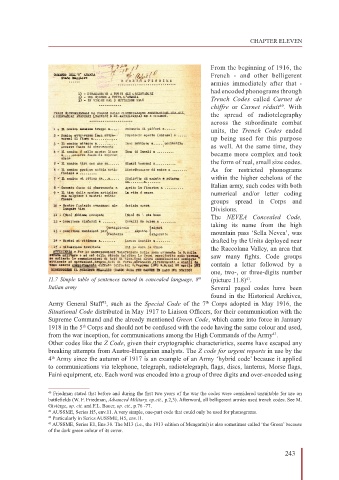
                                                                           The  NEVEA  Concealed  Code,
                                                                           taking  its name  from the  high
                                                                           mountain pass ‘Sella Nevea’, was
                                                                           drafted by the Units deployed near
                                                                           the Raccolana Valley, an area that
                                                                           saw  many  fights.  Code  groups
                                                                           contain  a  letter  followed  by  a
                                                                           one,  two-, or three-digits  number
                  11.7 Simple table of sentences turned in concealed language, 8    (picture 11.8) .
                                                                                       41
                                                                       th
                  Italian army                                             Several  paged  codes have  been
                                                                           found in the Historical Archives,
                  Army  General  Staff ,  such  as  the  Special  Code  of  the  7   Corps adopted  in  May  1916,  the
                                     42
                                                                         th
                  Situational Code distributed in May 1917 to Liaison Officers, for their communication with the
                  Supreme Command and the already mentioned Green Code, which came into force in January
                  1918 in the 5  Corps and should not be confused with the code having the same colour and used,
                              th
                  from the war inception, for communications among the High Commands of the Army .
                                                                                                 43
                  Other codes like the Z Code, given their cryptographic characteristics, seems have escaped any
                  breaking attempts from Austro-Hungarian analysts. The Z code for urgent reports in use by the
                  4  Army since the autumn of 1917 is an example of an Army ‘hybrid code’ because it applied
                   th
                  to communications via telephone, telegraph, radiotelegraph, flags, discs, lanterns, Morse flags,
                  Faini equipment, etc. Each word was encoded into a group of three digits and over-encoded using


                  40  Friedman stated that before and during the first two years of the war the codes were considered unsuitable for use on
                  battlefields (W. F. Friedman, Advanced Military, op.cit., p.2,3). Afterword, all belligerent armies used trench codes. See M.
                  Giviérge, op. cit. and F.L. Bauer, op. cit., p.76 -77.
                  41  AUSSME, Series H5, env.11. A very simple, one-part code that could only be used for phonograms.
                  42  Particularly in Series AUSSME, H5, env.11.
                  43  AUSSME, Series E1, Env.38. The M13 (i.e., the 1913 edition of Mengarini) is also sometimes called ‘the Green’ because
                  of the dark green colour of its cover.


                                                                                                     243

