


Page 291 - The Secret War in the Italian front in WWI (1915-1918)
P. 291
CHAPTER THIRTEEN


                                                                                A Balance of Forces


                  13.1  SPREADING OF RADIO AND CRYPTOLOGY IN THE ITALIAN ARMY


                  radIo servIces dIffusIon

                  The radio systems available to the Italian Army in early 1918 allowed connections between higher
                  echelons and minor units at the front, aeronautical communications, anti-aircraft services, data
                  transmission for artillery, broadcasting of war bulletins and of meteorological data, etc .
                                                                                                  1
                  The location of stations dedicated to those different activities across the front were shown in maps like
                  that included in picture 13.1 which also encompass telephone interception stations and geo-telegraphy
                  systems. The number of radio equipment in the field was growing at a fast rate, despite the reduction
                  in the size of the combat front compared to the period prior to October 1917, also depending on the
                  urgent requests for new connections coming from combat units. The limitation to a further spread of
                  radio devices stemmed from the restricted production capacity of the manufacturers so that, to cope
                  with the scarcity of supplies, the Army tried to increase its own production by establishing the Electro-
                  technical and Radiotelegraphic Construction Workshop in Rome, during 1917 . Nevertheless, the supply
                                                                                     2
                  of telecommunications equipment continued to be unsatisfactory until the end of the conflict.
                  Radio communications devices were in high demand within the Divisions, as the war increasingly
                  demonstrated the fragility of other means.
                  Indeed, the Brigade Headquarters had
                  received some ‘trench stations’ since the
                  beginning of the year, but the distribution
                  to all Brigades was not completed before
                  the  end  of  the  conflict  also  because
                  the  difficulties  of  extending  adequate
                  training to a large amount of operators.
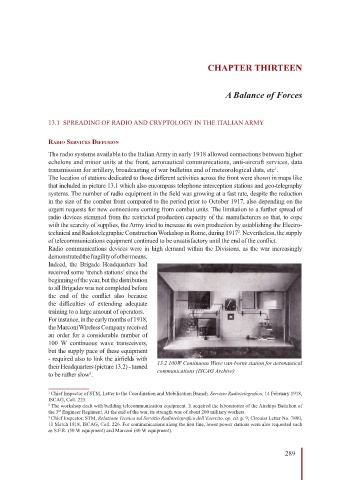
                  For instance, in the early months of 1918,
                  the Marconi Wireless Company received
                  an order for a considerable number of
                  100  W continuous  wave  transceivers,
                  but the supply pace of these equipment
                  - required also to link the airfields with
                  their Headquarters (picture 13.2) - turned   13.2 100W Continuous Wave van-borne station for aeronautical
                  to be rather slow .                   communications (ISCAG Archive)
                                3


                  1  Chief Inspector of STM, Letter to the Coordination and Mobilisation Branch, Servizio Radiotelegrafico, 14 February 1918,
                  ISCAG, Coll. 225.
                  2  The workshop dealt with building telecommunication equipment. It acquired the laboratories of the Airships Battalion of
                  the 3  Engineer Regiment. At the end of the war, its strength was of about 200 military workers.
                      rd
                  3  Chief Inspector, STM, Relazione Tecnica sul Servizio Radiotelegrafico dell’Esercito, op. cit. p. 9; Circular Letter No. 7880,
                  11 March 1818, ISCAG, Coll. 226. For communications along the first line, lower power stations were also requested such
                  as S.F.R. (50 W equipment) and Marconi (40 W equipment).


                                                                                                     289

