


Page 293 - The Secret War in the Italian front in WWI (1915-1918)
P. 293
CHAPTER THIRTEEN


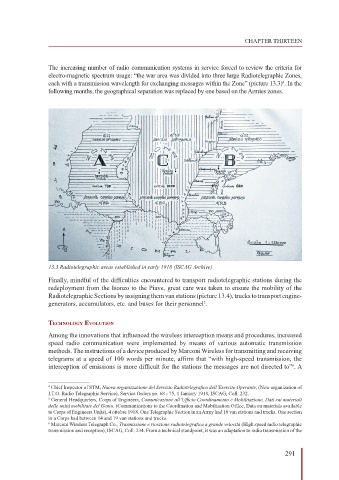
                  The increasing number of radio communication systems in service forced to review the criteria for
                  electro-magnetic spectrum usage: “the war area was divided into three large Radiotelegraphic Zones,
                  each with a transmission wavelength for exchanging messages within the Zone” (picture 13.3) . In the
                                                                                                    4
                  following months, the geographical separation was replaced by one based on the Armies zones.


                  13.3 Radiotelegraphic areas established in early 1918 (ISCAG Archive)
                  Finally, mindful of the difficulties encountered to transport radiotelegraphic stations during the
                  redeployment from the Isonzo to the Piave, great care was taken to ensure the mobility of the
                  Radiotelegraphic Sections by assigning them van stations (picture 13.4), trucks to transport engine-
                  generators, accumulators, etc. and buses for their personnel .
                                                                         5

                  Technology evoluTIon
                  Among the innovations that influenced the wireless interception means and procedures, increased
                  speed radio communication were implemented  by means of various automatic  transmission
                  methods. The instructions of a device produced by Marconi Wireless for transmitting and receiving
                  telegrams at a speed of 100 words per minute, affirm that “with high-speed transmission, the
                  interception of emissions is more difficult for the stations the messages are not directed to” . A
                                                                                                        6


                  4  Chief Inspector of STM, Nuova organizzazione del Servizio Radiotelegrafico dell’Esercito Operante, (New organization of
                  I.T.O. Radio Telegraphic Service), Service Orders no. 68 - 75, 1 January 1918, ISCAG, Coll. 232.
                  5  General Headquarters, Corps of Engineers, Comunicazione all’Ufficio Coordinamento e Mobilitazione, Dati sui materiali
                  delle unità mobilitate del Genio, (Communications to the Coordination and Mobilization Office, Data on materials available
                  to Corps of Engineers Units), 4 ottobre 1918. One Telegraphic Section in an Army had 10 van stations and trucks. One section
                  in a Corps had between 14 and 19 van stations and trucks.
                  6  Marconi Wireless Telegraph Co., Trasmissione e ricezione radiotelegrafica a grande velocità (High speed radio telegraphic
                  transmission and reception), ISCAG, Coll. 234. From a technical standpoint, it was an adaptation to radio transmission of the


                                                                                                     291

