


Page 294 - The Secret War in the Italian front in WWI (1915-1918)
P. 294
THE SECRET WAR ON THE ITALIAN FRONT IN WWI (1915 – 1918)


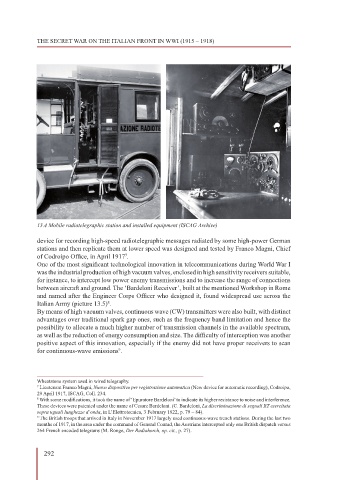
              13.4 Mobile radiotelegraphic station and installed equipment (ISCAG Archive)


              device for recording high-speed radiotelegraphic messages radiated by some high-power German
              stations and then replicate them at lower speed was designed and tested by Franco Magni, Chief
              of Codroipo Office, in April 1917 .
                                             7
              One of the most significant technological innovation in telecommunications during World War I
              was the industrial production of high vacuum valves, enclosed in high sensitivity receivers suitable,
              for instance, to intercept low power enemy transmissions and to increase the range of connections
              between aircraft and ground. The ‘Bardeloni Receiver’, built at the mentioned Workshop in Rome
              and named after the Engineer Corps Officer who designed it, found widespread use across the
              Italian Army (picture 13.5) .
                                       8
              By means of high vacuum valves, continuous wave (CW) transmitters were also built, with distinct
              advantages over traditional spark gap ones, such as the frequency band limitation and hence the
              possibility to allocate a much higher number of transmission channels in the available spectrum,
              as well as the reduction of energy consumption and size. The difficulty of interception was another
              positive aspect of this innovation, especially if the enemy did not have proper receivers to scan
              for continuous-wave emissions .
                                           9


              Wheatstone system used in wired telegraphy.
              7  Lieutenant Franco Magni, Nuovo dispositivo per registrazione automatica (New device for automatic recording), Codroipo,
              29 April 1917, ISCAG, Coll. 234.
              8  With some modifications, it took the name of ‘Epuratore Bardeloni’ to indicate its higher resistance to noise and interference.
              These devices were patented under the name of Cesare Bardeloni. (C. Bardeloni, La discriminazione di segnali RT esercitata
              sopra uguali lunghezze d’onda, in L’Elettrotecnica, 3 February 1922, p. 79 – 84).
              9  The British troops that arrived in Italy in November 1917 largely used continuous-wave trench stations. During the last two
              months of 1917, in the area under the command of General Conrad, the Austrians intercepted only one British dispatch versus
              264 French encoded telegrams (M. Ronge, Der Radiohorch, op. cit., p. 27).


                292

