


Page 52 - The Secret War in the Italian front in WWI (1915-1918)
P. 52
THE SECRET WAR ON THE ITALIAN FRONT IN WWI (1915 – 1918)


              They talked about the Austro-
              Hungarian military policy of
              the time, the organisational
              structure  of the  Austro-
              Hungarian  Army and the
              Double Monarchy’s defensive
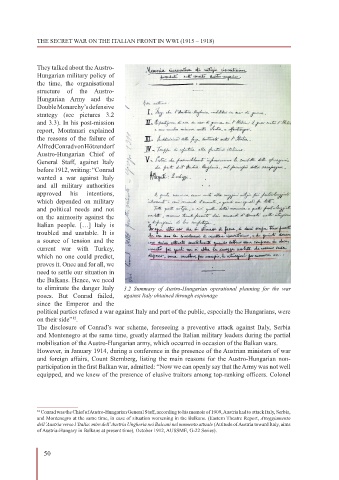
              strategy (see pictures 3.2
              and 3.3). In his post-mission
              report,  Montanari  explained
              the  reasons of the  failure  of
              Alfred Conrad von Hötzendorf
              Austro-Hungarian Chief  of
              General  Staff, against  Italy
              before 1912, writing: “Conrad
              wanted a war against Italy
              and all military  authorities
              approved    his  intentions,
              which  depended  on  military
              and political  needs and not
              on the animosity against the
              Italian  people. […] Italy is
              troubled  and unstable.  It is
              a source of tension and the
              current war with  Turkey,
              which no one could predict,
              proves it. Once and for all, we
              need to settle our situation in
              the Balkans. Hence, we need
              to eliminate the danger Italy   3.2  Summary  of  Austro-Hungarian  operational  planning  for  the  war
              poses. But Conrad failed,      against Italy obtained through espionage
              since the Emperor and the
              political parties refused a war against Italy and part of the public, especially the Hungarians, were
              on their side” .
                          12
              The  disclosure  of Conrad’s war scheme,  foreseeing  a preventive  attack  against  Italy, Serbia
              and Montenegro at the same time, greatly alarmed the Italian military leaders during the partial
              mobilisation of the Austro-Hungarian army, which occurred in occasion of the Balkan wars.
              However, in January 1914, during a conference in the presence of the Austrian ministers of war
              and  foreign  affairs,  Count  Sternberg, listing  the  main  reasons for the Austro-Hungarian  non-
              participation in the first Balkan war, admitted: “Now we can openly say that the Army was not well
              equipped, and we knew of the presence of elusive traitors among top-ranking officers. Colonel


              12  Conrad was the Chief of Austro-Hungarian General Staff, according to his memoir of 1909, Austria had to attack Italy, Serbia,
              and Montenegro at the same time, in case of situation worsening in the Balkans. (Eastern Theatre Report, Atteggiamento
              dell’Austria verso l’Italia: mire dell’Austria Ungheria nei Balcani nel momento attuale (Attitude of Austria toward Italy, aims
              of Austria-Hungary in Balkans at present time), October 1912, AUSSME, G-22 Series).


                50

