


Page 326 - Airpower in 20th Century - Doctrines and Employment
P. 326
326                         airpower in 20  Century doCtrines and employment - national experienCes
                                             tH


                                                                        tive   balloon
                                                                        vessel   named
                                                                        Manica  leaving
                                                                        Britain  arrived
                                                                        the  Strait  of
                                                                        Çanakkale  on
                                                                        22  March.  On
                                                                        March 26, Cap-
                                                                        tain  Serno  and
                                                                        Captain Schnei-
                                                                        der  conducted
                                                                        a  new  aerial
                                                                        reconnaissance,
                                                                        which  was  re-
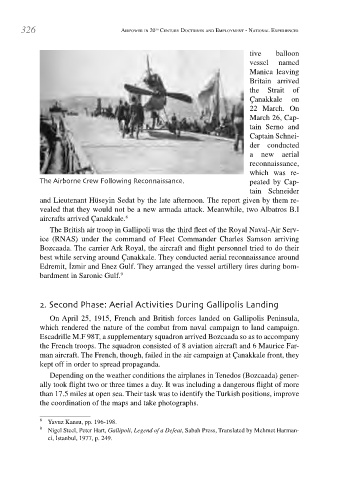
            The Airborne Crew Following Reconnaissance.                 peated  by  Cap-
                                                                        tain  Schneider
            and Lieutenant Hüseyin Sedat by the late afternoon. The report given by them re-
            vealed that they would not be a new armada attack. Meanwhile, two Albatros B.I
            aircrafts arrived Çanakkale. 8
               The British air troop in Gallipoli was the third fleet of the Royal Naval-Air Serv-
            ice  (RNAS)  under  the  command  of  Fleet  Commander  Charles  Samson  arriving
            Bozcaada. The carrier Ark Royal, the aircraft and flight personnel tried to do their
            best while serving around Çanakkale. They conducted aerial reconnaissance around
            Edremit, İzmir and Enez Gulf. They arranged the vessel artillery fires during bom-
            bardment in Saronic Gulf. 9


            2. Second Phase: Aerial Activities During Gallipolis Landing

               On April 25, 1915, French and British forces landed on Gallipolis Peninsula,
            which rendered the nature of the combat from naval campaign to land campaign.
            Escadrille M.F 98T, a supplementary squadron arrived Bozcaada so as to accompany
            the French troops. The squadron consisted of 8 aviation aircraft and 6 Maurice Far-
            man aircraft. The French, though, failed in the air campaign at Çanakkale front, they
            kept off in order to spread propaganda.
               Depending on the weather conditions the airplanes in Tenedos (Bozcaada) gener-
            ally took flight two or three times a day. It was including a dangerous flight of more
            than 17.5 miles at open sea. Their task was to identify the Turkish positions, improve
            the coordination of the maps and take photographs.

            8
               Yavuz Kansu, pp. 196-198.
            9
               Nigel Steel, Peter Hart, Gallipoli, Legend of a Defeat, Sabah Press, Translated by Mehmet Harman-
               ci, İstanbul, 1977, p. 249.

