


Page 327 - Airpower in 20th Century - Doctrines and Employment
P. 327
turkIsh AIr cAmpAIgns durIng the bAttles of ÇAnAkkAle mArch 1915 - JAnuAry 1916  327


               While  the  land  airplanes  were  continuing
            to conduct operations in Tenedos (Bozcaada)
            HMS Ark Royal was utilizing its seaplanes in
            the vicinity of İzmir and Enez for the mission
            of long-range reconnaissance. 10
               By  the  arrival  of  the  German  submarines
            the HMS Ark Royal, which was slow in mo-
            tion and vulnerable was first sent to the Mudros
            Port and then to Salonika to serve as aircraft
            carrier. It was replaced by HMSBen-my-Chree
            equipped with five seaplanes.
               Çanakkale  Front  was  not  only  witness  to
            the use of land and seaplanes but also to an-
            other “first”. It caused the fact that the balloon
            activities increased in the Royal Navy and that
            Major General Birdwood asked for free or tied
            balloons to help identify the distribution of the
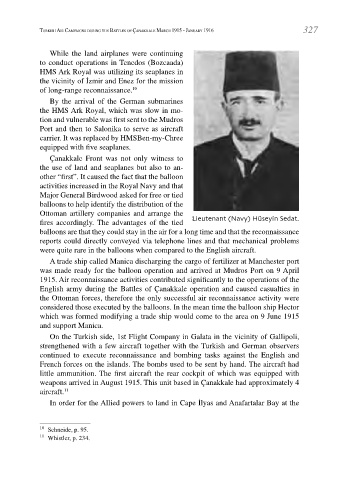
            Ottoman artillery companies and arrange the   Lieutenant (Navy) Hüseyin Sedat.
            fires accordingly. The advantages of the tied
            balloons are that they could stay in the air for a long time and that the reconnaissance
            reports could directly conveyed via telephone lines and that mechanical problems
            were quite rare in the balloons when compared to the English aircraft.
               A trade ship called Manica discharging the cargo of fertilizer at Manchester port
            was made ready for the balloon operation and arrived at Mudros Port on 9 April
            1915. Air reconnaissance activities contributed significantly to the operations of the
            English army during the Battles of Çanakkale operation and caused casualties in
            the Ottoman forces, therefore the only successful air reconnaissance activity were
            considered those executed by the balloons. In the mean time the balloon ship Hector
            which was formed modifying a trade ship would come to the area on 9 June 1915
            and support Manica.
               On the Turkish side, 1st Flight Company in Galata in the vicinity of Gallipoli,
            strengthened with a few aircraft together with the Turkish and German observers
            continued  to  execute  reconnaissance  and  bombing  tasks  against  the  English  and
            French forces on the islands. The bombs used to be sent by hand. The aircraft had
            little ammunition. The first aircraft the rear cockpit of which was equipped with
            weapons arrived in August 1915. This unit based in Çanakkale had approximately 4
            aircraft. 11
               In order for the Allied powers to land in Cape İlyas and Anafartalar Bay at the


            10
                Schneide, p. 95.
            11
                Whistler, p. 234.

