


Page 328 - Airpower in 20th Century - Doctrines and Employment
P. 328
328                         airpower in 20  Century doCtrines and employment - national experienCes
                                             tH


                                                               edge of Gallipoli peninsu-
                                                               la on 25 April 1915 neces-
                                                               sitated new air reconnais-
                                                               sance.  In  the  morning  of
                                                               25 April  as  predicted  by
                                                               Lieutenant  Colonel  Mus-
                                                               tafa  Kemal  the  English
                                                               powers  started  a  landing
                                                               operation  from  Sedd-el
                                                               Bahr  with  the  Austral-
                                                               ians  and  from  the  north
                                                               of  Kaba  Tepe  with  the
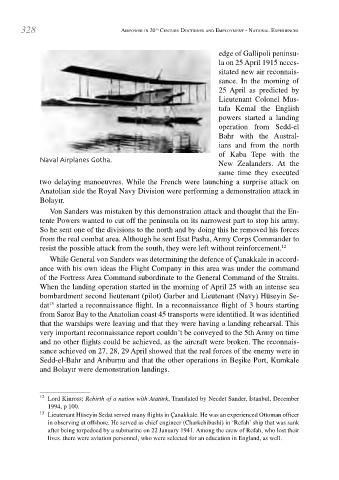
            Naval Airplanes Gotha.
                                                               New  Zealanders.  At  the
                                                               same  time  they  executed
            two delaying manoeuvres. While the French were launching a surprise attack on
            Anatolian side the Royal Navy Division were performing a demonstration attack in
            Bolayır.
               Von Sanders was mistaken by this demonstration attack and thought that the En-
            tente Powers wanted to cut off the peninsula on its narrowest part to stop his army.
            So he sent one of the divisions to the north and by doing this he removed his forces
            from the real combat area. Although he sent Esat Pasha, Army Corps Commander to
            resist the possible attack from the south, they were left without reinforcement. 12
               While General von Sanders was determining the defence of Çanakkale in accord-
            ance with his own ideas the Flight Company in this area was under the command
            of the Fortress Area Command subordinate to the General Command of the Straits.
            When the landing operation started in the morning of April 25 with an intense sea
            bombardment second lieutenant (pilot) Garber and Lieutenant (Navy) Hüseyin Se-
               13
            dat  started a reconnaissance flight. In a reconnaissance flight of 3 hours starting
            from Saroz Bay to the Anatolian coast 45 transports were identified. It was identified
            that the warships were leaving and that they were having a landing rehearsal. This
            very important reconnaissance report couldn’t be conveyed to the 5th Army on time
            and no other flights could be achieved, as the aircraft were broken. The reconnais-
            sance achieved on 27, 28, 29 April showed that the real forces of the enemy were in
            Sedd-el-Bahr and Arıburnu and that the other operations in Beşike Port, Kumkale
            and Bolayır were demonstration landings.


            12
                Lord Kinross; Rebirth of a nation with Atatürk, Translated by Necdet Sander, İstanbul, December
               1994, p 100.
            13
                Lieutenant Hüseyin Sedat served many flights in Çanakkale. He was an experienced Ottoman officer
               in observing at offshore. He served as chief engineer (Charkchibashi) in ʻRefahʼ ship that was sank
               after being torpedoed by a submarine on 22 January 1941. Among the crew of Refah, who lost their
               lives. there were aviation personnel, who were selected for an education in England, as well.

