


Page 333 - Airpower in 20th Century - Doctrines and Employment
P. 333
turkIsh AIr cAmpAIgns durIng the bAttles of ÇAnAkkAle mArch 1915 - JAnuAry 1916  333


            damaging  all  supplies  and  equipments  were  observed.
            Meanwhile, Turkish aviation units launched 32 bombs
            and hit 17 targets in Sedd-el-Bahr (Seddülbahir) camp.
            Moreover two equipment hangars in Mudros (Mondros)
            Bay and an airplane hangar in Tenedos (Bozcaada) were
            demolished and four shots fell down at close range of
            enemy ships. In 1916, upon coming to Çanakkale in the
            first week of December Fokker Fighter Company (6th
            Fighter Company) took part in the operation. On January
            4,  1916  Pilot  First  Lieutenant  Schubert,  from  German
            Maritime Airplane Company, hit one of the airplanes of
            French Maurice Farman and made it shoot down. 25
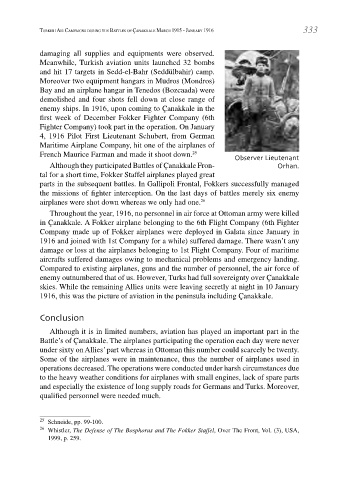
                                                                    Observer Lieutenant
               Although they participated Battles of Çanakkale Fron-            Orhan.
            tal for a short time, Fokker Staffel airplanes played great
            parts in the subsequent battles. In Gallipoli Frontal, Fokkers successfully managed
            the missions of fighter interception. On the last days of battles merely six enemy
            airplanes were shot down whereas we only had one. 26
               Throughout the year, 1916, no personnel in air force at Ottoman army were killed
            in Çanakkale. A Fokker airplane belonging to the 6th Flight Company (6th Fighter
            Company made up of Fokker airplanes were deployed in Galata since January in
            1916 and joined with 1st Company for a while) suffered damage. There wasn’t any
            damage or loss at the airplanes belonging to 1st Flight Company. Four of maritime
            aircrafts suffered damages owing to mechanical problems and emergency landing.
            Compared to existing airplanes, guns and the number of personnel, the air force of
            enemy outnumbered that of us. However, Turks had full sovereignty over Çanakkale
            skies. While the remaining Allies units were leaving secretly at night in 10 January
            1916, this was the picture of aviation in the peninsula including Çanakkale.

            Conclusion

               Although it is in limited numbers, aviation has played an important part in the
            Battle’s of Çanakkale. The airplanes participating the operation each day were never
            under sixty on Allies’ part whereas in Ottoman this number could scarcely be twenty.
            Some of the airplanes were in maintenance, thus the number of airplanes used in
            operations decreased. The operations were conducted under harsh circumstances due
            to the heavy weather conditions for airplanes with small engines, lack of spare parts
            and especially the existence of long supply roads for Germans and Turks. Moreover,
            qualified personnel were needed much.


            25
                Schneide, pp. 99-100.
            26
                Whistler, The Defense of The Bosphorus and The Fokker Staffel, Over The Front, Vol. (3), USA,
               1999, p. 259.

