


Page 329 - Airpower in 20th Century - Doctrines and Employment
P. 329
turkIsh AIr cAmpAIgns durIng the bAttles of ÇAnAkkAle mArch 1915 - JAnuAry 1916  329


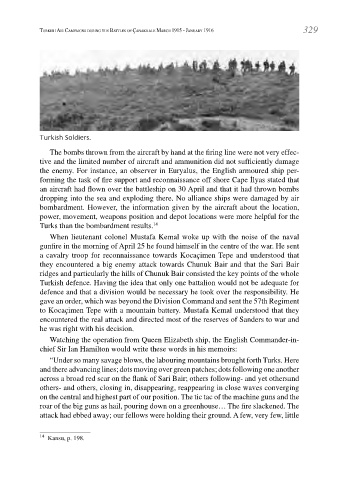
            Turkish Soldiers.
               The bombs thrown from the aircraft by hand at the firing line were not very effec-
            tive and the limited number of aircraft and ammunition did not sufficiently damage
            the enemy. For instance, an observer in Euryalus, the English armoured ship per-
            forming the task of fire support and reconnaissance off shore Cape İlyas stated that
            an aircraft had flown over the battleship on 30 April and that it had thrown bombs
            dropping into the sea and exploding there. No alliance ships were damaged by air
            bombardment. However, the information given by the aircraft about the location,
            power, movement, weapons position and depot locations were more helpful for the
            Turks than the bombardment results. 14
               When lieutenant colonel Mustafa Kemal woke up with the noise of the naval
            gunfire in the morning of April 25 he found himself in the centre of the war. He sent
            a cavalry troop for reconnaissance towards Kocaçimen Tepe and understood that
            they encountered a big enemy attack towards Chunuk Bair and that the Sari Bair
            ridges and particularly the hills of Chunuk Bair consisted the key points of the whole
            Turkish defence. Having the idea that only one battalion would not be adequate for
            defence and that a division would be necessary he took over the responsibility. He
            gave an order, which was beyond the Division Command and sent the 57th Regiment
            to Kocaçimen Tepe with a mountain battery. Mustafa Kemal understood that they
            encountered the real attack and directed most of the reserves of Sanders to war and
            he was right with his decision.
               Watching the operation from Queen Elizabeth ship, the English Commander-in-
            chief Sir Ian Hamilton would write these words in his memoirs:
               “Under so many savage blows, the labouring mountains brought forth Turks. Here
            and there advancing lines; dots moving over green patches; dots following one another
            across a broad red scar on the flank of Sari Bair; others following- and yet othersand
            others- and others, closing in, disappearing, reappearing in close waves converging
            on the central and highest part of our position. The tic tac of the machine guns and the
            roar of the big guns as hail, pouring down on a greenhouse… The fire slackened. The
            attack had ebbed away; our fellows were holding their ground. A few, very few, little


            14
                Kansu, p. 198.

