


Page 188 - Le donne nel primo conflitto mondiale - Dalle linee avanzate al fronte interno: La grande guerra delle italiane - Atti 25-26 novembre 2015
P. 188
LE DONNE NEL PRIMO CONFLITTO MONDIALE                                      188


             The remaining women were classified as widows or divorced.
                                                                      18
             The major reasons for punitive dismissals were theft, offences against service in-
          cumbencies and staying away from service. There were many cases in which dismissals
          resulted from alleged or proven ‘immorality’. That in many cases not the punished
          women but soldiers or male employees initiated those ‘immoralities’ was not taken
          into account. 19


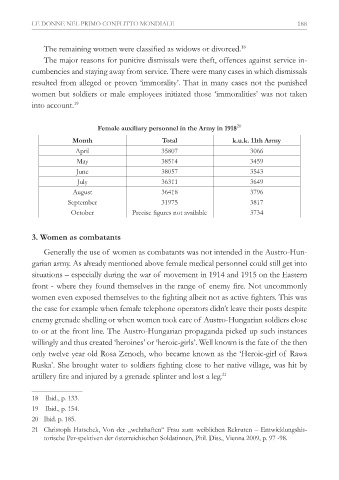
                             Female auxiliary personnel in the Army in 1918 20
                      Month                    Total               k.u.k. 11th Army
                      April                    35807                    3066
                       May                     38514                    3459
                       June                    38057                    3543
                       July                    36311                    3649
                      August                   36418                    3796
                    September                  31975                    3817
                     October           Precise figures not available    3734


          3. Women as combatants

             Generally the use of women as combatants was not intended in the Austro-Hun-
          garian army. As already mentioned above female medical personnel could still get into
          situations – especially during the war of movement in 1914 and 1915 on the Eastern
          front - where they found themselves in the range of enemy fire. Not uncommonly
          women even exposed themselves to the fighting albeit not as active fighters. This was
          the case for example when female telephone operators didn’t leave their posts despite
          enemy grenade shelling or when women took care of Austro-Hungarian soldiers close
          to or at the front line. The Austro-Hungarian propaganda picked up such instances
          willingly and thus created ‘heroines’ or ‘heroic-girls’. Well known is the fate of the then
          only twelve year old Rosa Zenoch, who became known as the ‘Heroic-girl of Rawa
          Ruska’. She brought water to soldiers fighting close to her native village, was hit by
          artillery fire and injured by a grenade splinter and lost a leg. 21


          18   Ibid., p. 133.
          19   Ibid., p. 154.
          20  Ibid. p. 185.
          21  Christoph Hatschek, Von der „wehrhaften“ Frau zum weiblichen Rekruten – Entwicklungshis-
             torische Per-spektiven der österreichischen Soldatinnen, Phil. Diss., Vienna 2009, p. 97 -98.


   II-sessione.indd   188                                                               05/05/16   10:32

