


Page 362 - Lanzarotto Malocello from Italy to the Canary Islands
P. 362
362                                             from Italy to the Canary Islands


                                                                African  influences
                                                                are also evident.
                                                                   Archaeological
                                                                studies  show that
                                                                each  island  had  a
                                                                very different  social
                                                                and political  struc-
                                                                ture. However, they
                                                                all had a monar-
                                                                chical  structure,  al-
                                                                though the royal title
                                                                differed; for exam-
                                                                ple, “Guanarteme”
                                                                in Gran Canaria,
                                                                “Mencey”  in Tener-
                                                                ife. Kings were as-
                                                                sisted by members of
                                                                the nobility; it would
                                                                appear that the latter
                                                                was  not just hered-
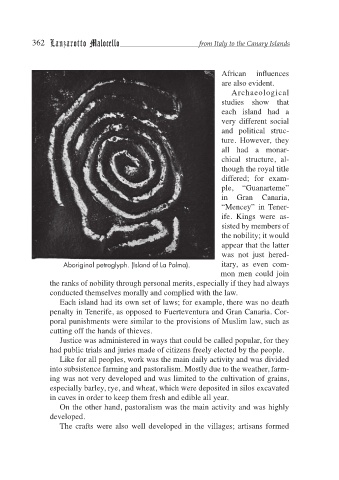
                   Aboriginal petroglyph. (Island of La Palma).  itary, as even com-
                                                                mon men could join
               the ranks of nobility through personal merits, especially if they had always
               conducted themselves morally and complied with the law.
                  Each island had its own set of laws; for example, there was no death
               penalty in Tenerife, as opposed to Fuerteventura and Gran Canaria. Cor-
               poral punishments were similar to the provisions of Muslim law, such as
               cutting off the hands of thieves.
                  Justice was administered in ways that could be called popular, for they
               had public trials and juries made of citizens freely elected by the people.
                  Like for all peoples, work was the main daily activity and was divided
               into subsistence farming and pastoralism. Mostly due to the weather, farm-
               ing was not very developed and was limited to the cultivation of grains,
               especially barley, rye, and wheat, which were deposited in silos excavated
               in caves in order to keep them fresh and edible all year.
                  On the other hand, pastoralism was the main activity and was highly
               developed.
                  The crafts were also well developed in the villages; artisans formed

