


Page 358 - Lanzarotto Malocello from Italy to the Canary Islands
P. 358
358                                             from Italy to the Canary Islands


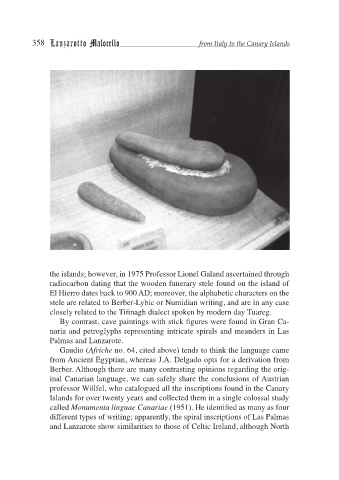
               the islands; however, in 1975 Professor Lionel Galand ascertained through
               radiocarbon dating that the wooden funerary stele found on the island of
               El Hierro dates back to 900 AD; moreover, the alphabetic characters on the
               stele are related to Berber-Lybic or Numidian writing, and are in any case
               closely related to the Tifinagh dialect spoken by modern day Tuareg.
                  By contrast, cave paintings with stick figures were found in Gran Ca-
               naria and petroglyphs representing intricate spirals and meanders in Las
               Palmas and Lanzarote.
                  Gaudio (Afriche no. 64, cited above) tends to think the language came
               from Ancient Egyptian, whereas J.A. Delgado opts for a derivation from
               Berber. Although there are many contrasting opinions regarding the orig-
               inal Canarian language, we can safely share the conclusions of Austrian
               professor Wölfel, who catalogued all the inscriptions found in the Canary
               Islands for over twenty years and collected them in a single colossal study
               called Monumenta linguae Canariae (1951). He identified as many as four
               different types of writing; apparently, the spiral inscriptions of Las Palmas
               and Lanzarote show similarities to those of Celtic Ireland, although North

