


Page 354 - Lanzarotto Malocello from Italy to the Canary Islands
P. 354
354                                             from Italy to the Canary Islands


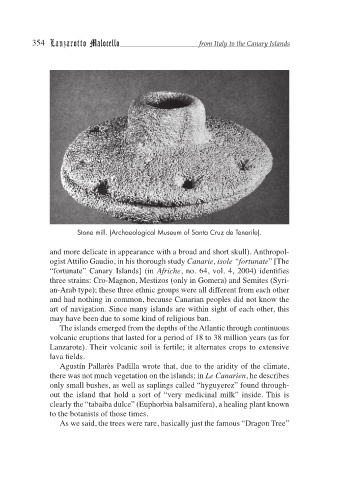
                       Stone mill. (Archaeological Museum of Santa Cruz de Tenerife).


               and more delicate in appearance with a broad and short skull). Anthropol-
               ogist Attilio Gaudio, in his thorough study Canarie, isole “fortunate” [The
               “fortunate” Canary Islands] (in Afriche, no. 64, vol. 4, 2004) identifies
               three strains: Cro-Magnon, Mestizos (only in Gomera) and Semites (Syri-
               an-Arab type); these three ethnic groups were all different from each other
               and had nothing in common, because Canarian peoples did not know the
               art of navigation. Since many islands are within sight of each other, this
               may have been due to some kind of religious ban.
                  The islands emerged from the depths of the Atlantic through continuous
               volcanic eruptions that lasted for a period of 18 to 38 million years (as for
               Lanzarote). Their volcanic soil is fertile; it alternates crops to extensive
               lava fields.
                  Agustín Pallarès Padilla wrote that, due to the aridity of the climate,
               there was not much vegetation on the islands; in le Canarien, he describes
               only small bushes, as well as saplings called “hyguyerez” found through-
               out the island that hold a sort of “very medicinal milk” inside. This is
               clearly the “tabaiba dulce” (Euphorbia balsamifera), a healing plant known
               to the botanists of those times.
                  As we said, the trees were rare, basically just the famous “Dragon Tree”

