


Page 356 - Lanzarotto Malocello from Italy to the Canary Islands
P. 356
356                                             from Italy to the Canary Islands


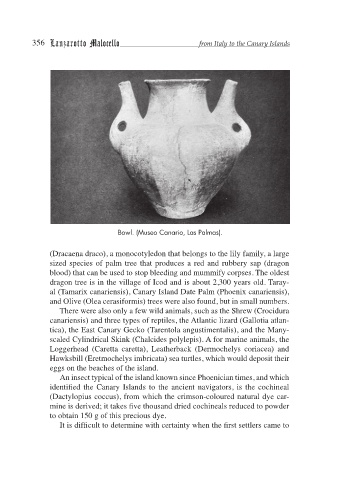
                                   Bowl. (Museo Canario, Las Palmas).


               (Dracaena draco), a monocotyledon that belongs to the lily family, a large
               sized species of palm tree that produces a red and rubbery sap (dragon
               blood) that can be used to stop bleeding and mummify corpses. The oldest
               dragon tree is in the village of Icod and is about 2,300 years old. Taray-
               al (Tamarix canariensis), Canary Island Date Palm (Phoenix canariensis),
               and Olive (Olea cerasiformis) trees were also found, but in small numbers.
                  There were also only a few wild animals, such as the Shrew (Crocidura
               canariensis) and three types of reptiles, the Atlantic lizard (Gallotia atlan-
               tica), the East Canary Gecko (Tarentola angustimentalis), and the Many-
               scaled Cylindrical Skink (Chalcides polylepis). A for marine animals, the
               Loggerhead (Caretta  caretta),  Leatherback  (Dermochelys coriacea)  and
               Hawksbill (Eretmochelys imbricata) sea turtles, which would deposit their
               eggs on the beaches of the island.
                  An insect typical of the island known since Phoenician times, and which
               identified the Canary Islands to the ancient navigators, is the cochineal
               (Dactylopius coccus), from which the crimson-coloured natural dye car-
               mine is derived; it takes five thousand dried cochineals reduced to powder
               to obtain 150 g of this precious dye.
                  It is difficult to determine with certainty when the first settlers came to

