


Page 58 - Lanzarotto Malocello from Italy to the Canary Islands
P. 58
58                                             from Italy to the Canary Islands


               The mystery of the sailor:

               Lanzarotto Malocello in the collective

               consciousness


                            hen we have little information about
                           a person, we perceive  the  need  to
                           fill  the  void  on  that  person’s  life.
               Sometimes just one word can light the way, with
               a knock-on effect that thus draws us into incon-
               ceivable worlds, of which we would never have
               dreamt. Places which are, of course, nothing other
               than words.
               One of the  many  ironies  of History is that  we
               can revisit a Roman emperor, whether from the
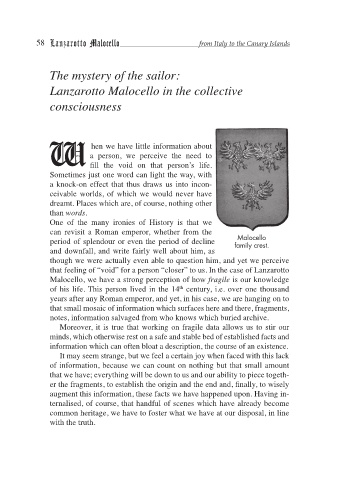
                                                                     Malocello
               period of splendour or even the period of decline    family crest.
               and downfall, and write fairly well about him, as
               though we were actually even able to question him, and yet we perceive
               that feeling of “void” for a person “closer” to us. In the case of Lanzarotto
               Malocello, we have a strong perception of how fragile is our knowledge
                                                    th
               of his life. This person lived in the 14  century, i.e. over one thousand
               years after any Roman emperor, and yet, in his case, we are hanging on to
               that small mosaic of information which surfaces here and there, fragments,
               notes, information salvaged from who knows which buried archive.
                  Moreover, it is true that working on fragile data allows us to stir our
               minds, which otherwise rest on a safe and stable bed of established facts and
               information which can often bloat a description, the course of an existence.
                  It may seem strange, but we feel a certain joy when faced with this lack
               of information, because we can count on nothing but that small amount
               that we have; everything will be down to us and our ability to piece togeth-
               er the fragments, to establish the origin and the end and, finally, to wisely
               augment this information, these facts we have happened upon. Having in-
               ternalised, of course, that handful of scenes which have already become
               common heritage, we have to foster what we have at our disposal, in line
               with the truth.

