


Page 103 - The Secret War in the Italian front in WWI (1915-1918)
P. 103
CHAPTER FIVE


                  already serving as interpreters, translators, and fiduciaries. Czech, but also Romanian, Polish,
                  and Yugoslav recruited patriots was largely engaged for questioning prisoners and as undercover
                  agents in concentration camps to extort military information from prisoners. Later, contact patrols
                  reporting to the Intelligence Service, went into action by approaching enemy lines at night to
                  convince the sentinels to surrender and join the Italian ranks, by means of patriotic songs and
                  throwing leaflets and food.
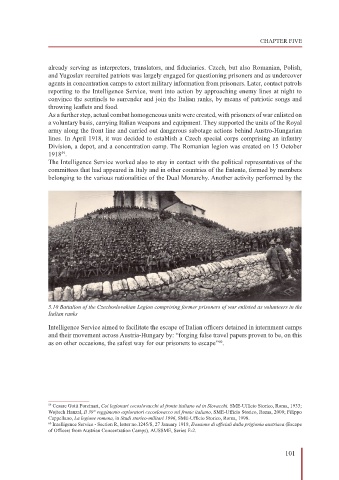
                  As a further step, actual combat homogeneous units were created, with prisoners of war enlisted on
                  a voluntary basis, carrying Italian weapons and equipment. They supported the units of the Royal
                  army along the front line and carried out dangerous sabotage actions behind Austro-Hungarian
                  lines. In April 1918, it was decided to establish a Czech special corps comprising an infantry
                  Division, a depot, and a concentration camp. The Romanian legion was created on 15 October
                  1918 .
                       59
                  The Intelligence Service worked also to stay in contact with the political representatives of the
                  committees that had appeared in Italy and in other countries of the Entente, formed by members
                  belonging to the various nationalities of the Dual Monarchy. Another activity performed by the


                  5.10 Battalion of the Czechoslovakian Legion comprising former prisoners of war enlisted as volunteers in the
                  Italian ranks

                  Intelligence Service aimed to facilitate the escape of Italian officers detained in internment camps
                  and their movement across Austria-Hungary by: “forging false travel papers proven to be, on this
                  as on other occasions, the safest way for our prisoners to escape” .
                                                                              60


                  59  Cesare Gotti Porcinari, Coi legionari cecoslovacchi al fronte italiano ed in Slovacchi, SME-Ufficio Storico, Roma, 1933;
                  Wojtech Hanzal, Il 39° reggimento esploratori cecoslovacco sul fronte italiano, SME-Ufficio Storico, Roma, 2009; Filippo
                  Cappellano, La legione romena, in Studi storico-militari 1996, SME-Ufficio Storico, Roma, 1998.
                  60  Intelligence Service - Section R, letter no.1245/S, 27 January 1918, Evasione di ufficiali dalla prigionia austriaca (Escape
                  of Officers from Austrian Concentration Camps), AUSSME, Series E-2.


                                                                                                     101

