


Page 102 - The Secret War in the Italian front in WWI (1915-1918)
P. 102
THE SECRET WAR ON THE ITALIAN FRONT IN WWI (1915 – 1918)


              Propaganda towards the enemy, aimed mainly at stirring internal conflict and encouraging ambitions
              of independence of the nationalities comprised within the Hapsburg Empire, gained strength by
              employing deserters and ‘unredeemed’ prisoners. One of the first and most active collaborators
              of the Italian Intelligence Service had been the Bohemian deserter Francesco Hlavacek who had
              reached the Italian lines on 10 August 1916, carrying many documents, maps, and sketches of
              enemy positions. After the initial questioning, he remained for about a month at the artillery
              Headquarters of the 2  Army corps and provided, moving from one lookout to the other, a lot of
                                  nd
              useful information on enemy positions. He then summed up the information and data collected
              over several months in a lucid report - a copy of which was sent to the Supreme Command - also
              containing a plan to attack the Bainsizza plateau .
                                                          56
              Before the Italian strike of May 1917, he was recalled to the war zone and employed by the 47
                                                                                                      th
              Division Headquarters, tasked with the military demonstration in Loga and Bodrez. On that occasion,
              he become an actual collaborator of the
              Headquarters and his suggestions proved
              to be extremely useful for the operation.
              He  then  personally  questioned  a  large
              part of Bohemian prisoners to identify
              the new defence  lines that the enemy
              had established on the plateau after his
              desertion.
              He  later  joined  the  Czechoslovakian
              Patriotic  Committee  located  in Rome.
              Before  the  Bainsizza  attack,  Hlavacek
              was once again recalled and assigned to
              the 24  Army Corps, in charge with the
                    th
              breakthrough .
                          57
              Starting    from      early    1918,
              Czechoslovakian,  Romanian,  Polish
              and Jugoslav prisoners were detained
              in concentration camps separated
              from  the  rest  of the Austro-Hungarian
              troopers, to facilitate  their recruitment
              as volunteers .
                          58
              In February 1918, the  Supreme
              Command asked the Ministry of  War
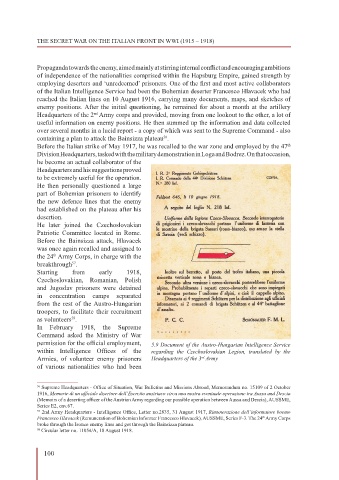
              permission for the official employment,   5.9 Document of the Austro-Hungarian Intelligence Service
              within  Intelligence  Offices  of  the   regarding  the  Czechoslovakian  Legion,  translated  by  the
              Armies, of volunteer  enemy  prisoners   Headquarters of the 3  Army
                                                                        rd
              of various nationalities  who had been


              56  Supreme Headquarters - Office of Situation, War Bulletins and Missions Abroad, Memorandum no. 15109 of 2 October
              1916, Memorie di un ufficiale disertore dell’Esercito austriaco circa una nostra eventuale operazione tra Aussa and Descia
              (Memoirs of a deserting officer of the Austrian Army regarding our possible operation between Aussa and Descia), AUSSME,
              Series E2, env.67.
              57  2nd Army Headquarters - Intelligence Office, Letter no.2835, 31 August 1917, Rimunerazione dell’informatore boemo
              Francesco Hlavacek (Remuneration of Bohemian Informer Francesco Hlavacek), AUSSME, Series F-3. The 24  Army Corps
                                                                                             th
              broke through the Isonzo enemy lines and got through the Bainsizza plateau.
              58  Circular letter no. 11054/A, 18 August 1918.


                100

