


Page 97 - The Secret War in the Italian front in WWI (1915-1918)
P. 97
CHAPTER FIVE


                  telephone eavesdropping section;
                  an aircraft, ground, and balloon
                  observation section; a study and
                  communication section.
                  A collection  centre  would
                  generally  only comprise  an
                  officer  heading  the  centre
                  supported by a certain number
                  of  non-commissioned  officers
                  and soldiers .
                             39
                  Under the new Regulations
                  issued in June 1918, the
                  Operational  Units  Intelligence
                  Offices  became  an  integral
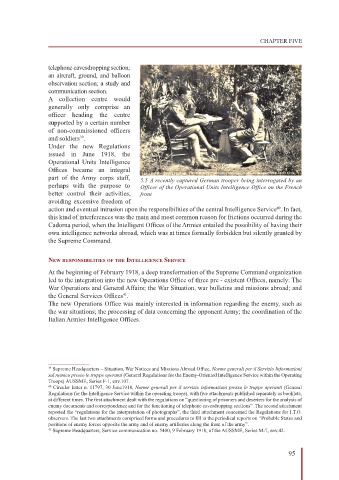
                  part of the  Army corps staff,   5.5 A recently captured German trooper being interrogated by an
                  perhaps  with  the  purpose to   Officer of the Operational Units Intelligence Office on the French
                  better  control  their  activities,   front
                  avoiding excessive freedom of
                  action and eventual intrusion upon the responsibilities of the central Intelligence Service . In fact,
                                                                                                  40
                  this kind of interferences was the main and most common reason for frictions occurred during the
                  Cadorna period, when the Intelligent Offices of the Armies entailed the possibility of having their
                  own intelligence networks abroad, which was at times formally forbidden but silently granted by
                  the Supreme Command.


                  new resPonsIbIlITIes of The InTellIgence servIce

                  At the beginning of February 1918, a deep transformation of the Supreme Command organization
                  led to the integration into the new Operations Office of three pre - existent Offices, namely: The
                  War Operations and General Affairs; the War Situation, war bulletins and missions abroad; and
                  the General Services Offices .
                                            41
                  The new Operations Office was mainly interested in information regarding the enemy, such as
                  the war situations; the processing of data concerning the opponent Army; the coordination of the
                  Italian Armies Intelligence Offices.


                  39  Supreme Headquarters – Situation, War Notices and Missions Abroad Office, Norme generali per il Servizio Informazioni
                  sul nemico presso le truppe operanti (General Regulations for the Enemy-Oriented Intelligence Service within the Operating
                  Troops) AUSSME, Series F-1, env.107.
                  40  Circular letter n. 11797, 30 June1918, Norme generali per il servizio informazioni presso le truppe operanti (General
                  Regulations for the Intelligence Service within the operating troops), with five attachments published separately as booklets,
                  at different times. The first attachment dealt with the regulations on “questioning of prisoners and deserters for the analysis of
                  enemy documents and correspondence and for the functioning of telephone eavesdropping sections”. The second attachment
                  reported the “regulations for the interpretation of photographs”, the third attachment concerned the Regulations for I.T.O.
                  observers. The last two attachments comprised forms and procedures to fill in the periodical reports on “Probable Status and
                  positions of enemy forces opposite the army and of enemy artilleries along the front of the army”.
                  41  Supreme Headquarters, Service communication no. 5400, 9 February 1918, of the AUSSME, Series M-7, env.42.


                                                                                                      95

