


Page 94 - The Secret War in the Italian front in WWI (1915-1918)
P. 94
THE SECRET WAR ON THE ITALIAN FRONT IN WWI (1915 – 1918)


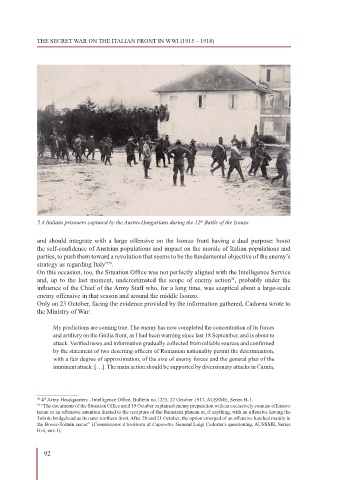
              5.4 Italians prisoners captured by the Austro-Hungarians during the 12  Battle of the Isonzo
                                                                       th

              and should integrate with a large offensive on the Isonzo front having a dual purpose: boost
              the self-confidence of Austrian populations and impact on the morale of Italian populations and
              parties, to push them toward a revolution that seems to be the fundamental objective of the enemy’s
              strategy as regarding Italy” .
                                       30
              On this occasion, too, the Situation Office was not perfectly aligned with the Intelligence Service
              and, up to the  last moment, underestimated  the  scope of enemy  action , probably  under the
                                                                                  31
              influence of the Chief of the Army Staff who, for a long time, was sceptical about a large-scale
              enemy offensive in that season and around the middle Isonzo.
              Only on 23 October, facing the evidence provided by the information gathered, Cadorna wrote to
              the Ministry of War:


                    My predictions are coming true. The enemy has now completed the concentration of its forces
                    and artillery on the Giulia front, as I had been warning since last 18 September, and is about to
                    attack. Verified news and information gradually collected from reliable sources and confirmed
                    by the statement of two deserting officers of Romanian nationality permit the determination,
                    with a fair degree of approximation, of the size of enemy forces and the general plan of the
                    imminent attack. […]. The main action should be supported by diversionary attacks in Carnia,


              30  4  Army Headquarters - Intelligence Office, Bulletin no.1225, 22 October 1917, AUSSME, Series B-1.
                th
              31  “The documents of the Situation Office until 19 October explained enemy preparation with an exclusively counter-offensive
              intent or an offensive intention limited to the recapture of the Bainsizza plateau or, if anything, with an offensive having the
              Tolmin bridgehead as its outer northern limit. After 20 and 21 October, the option emerged of an offensive lunched mainly in
              the Bovec-Tolmin sector” (Commissione d’inchiesta di Caporetto, General Luigi Cadorna’s questioning, AUSSME, Series
              H-4, env.1).


                92

