


Page 100 - The Secret War in the Italian front in WWI (1915-1918)
P. 100
THE SECRET WAR ON THE ITALIAN FRONT IN WWI (1915 – 1918)


              defeatist propaganda tended to depress the morale of the population and of combatants, as proven
              by an Intelligence report of December 1917:

                    On last 18 and 19 November, two secret meetings took place in Florence of members of
                    the leftist Leninist wing of the Socialist party […] During these meetings it was decided to
                    charge Leninist comrades working at auxiliary plants with: intensifying anti-war and desertion
                    propaganda; directing propaganda above all against the French and English influence, to be
                    blamed for fostering the continuation of war; disseminating incitement by clandestine press to
                    uprising against the bourgeoisie, showing Russia as an example where war actually stopped
                    after the revolution .
                                    49

              The P servIce
              Therefore, it was necessary to promote among Italian troops a vigorous counter-propaganda action
              along with more careful surveillance, but also to assist the soldiers through moral and material
              support, as a reaction to the Caporetto defeat.
              In January 1918, the Supreme Command  ordered the Headquarters  of large units to control
              the troops’ morale by a dedicated intelligence system to be staffed with confident and serious
              officers, carabinieri and police officers, but also with enlisted civilians having ascertained and
                                                                           unquestionable  political  and
                                                                           moral fibre .
                                                                                     50
                                                                           Selected fiduciaries were tasked
                                                                           to “mix with soldiers, listen
                                                                           to  speeches,  assess  feelings,
                                                                           ambitions,  and  shortcomings
                                                                           in order to be able, depending
                                                                           on the various opportunities, to
                                                                           assist them with comforting and
                                                                           reassuring words immediately”.
                                                                           In addition to informing superiors
                                                                           about the needs of troops in
                                                                           terms of assistance and welfare,
                                                                           they disseminated propaganda
                                                                           material, prepared conferences,
                                                                           organized recreational activities
                                                                           and shows in periods of rest in the
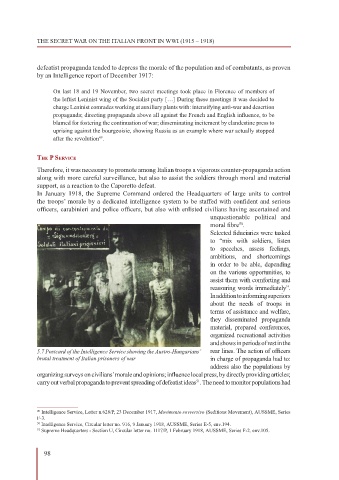
              5.7 Postcard of the Intelligence Service showing the Austro-Hungarians’   rear lines. The action of officers
              brutal treatment of Italian prisoners of war                 in charge of propaganda had to:
                                                                           address also the populations by
              organizing surveys on civilians’ morale and opinions; influence local press, by directly providing articles;
              carry out verbal propaganda to prevent spreading of defeatist ideas . The need to monitor populations had
                                                                      51


              49  Intelligence Service, Letter n.628/P, 23 December 1917, Movimento sovversivo (Seditious Movement), AUSSME, Series
              F-3.
              50  Intelligence Service, Circular letter no. 916, 9 January 1918, AUSSME, Series E-5, env.194.
              51  Supreme Headquarters - Section U, Circular letter no. 1117/P, 1 February 1918, AUSSME, Series F-2, env.105.


                98

