


Page 147 - The Secret War in the Italian front in WWI (1915-1918)
P. 147
CHAPTER SEVEN


                  up the interpretation of a large quantity of intercepted telegrams, Ronge set up a decryption service
                  (Dechiffrierdienst) initially comprising just one person, the above-mentioned Captain Andrea Figl,
                  who mastered the Italian language and “until the end of the war, with the exception of brief periods,
                  worked within the decrypting service against Italy, developing undeniable expertise in this field” .
                                                                                                         34
                  Moreover, Ronge tried to get as many Italian codes as possible, to facilitate decrypting of the
                  intercepted radio dispatches piling up in the archives.
                  Finally, after August  1914 Austro-Hungarian analysts had joined Russian and Balkan fronts,
                  developing a considerable experience in breaking enemy field ciphers, which proved useful in
                  order to decrypt Italian dispatches.
                  In  August  1914,  the  Austro-Hungarians  army  was  equipped  with  13  fixed  transmitting  and
                  receiving stations and 13 field stations, assigned to the Supreme Command (AOK) and to the
                  Armies’ Headquarters. Later they acquired low power equipment easily transportable on difficult
                  terrains, such as mountain areas, utilizing 11 of them on the Italian front for interception purposes
                  since November 1915 . Being convinced that listening to enemy radio communications would
                                       35
                  lead to considerable competitive advantage, the Austro-Hungarian used their radio resources more
                  to intercept enemy communications than for communicating between units of their own army.


                  ITalIan Troubles

                  Right before the war, the Italian
                  Supreme Command was aware of
                  the importance to intercept Austro-
                  Hungarian radio communications,
                  as shown by the correspondence
                  that  the Headquarters  of the
                  General Staff Corps sent to the
                  Mobilization  Office  in  August
                  1914,  to  request  that  “the  fixed
                  radio stations of Treviso, Arsiero,
                  Primolano, Pieve di Cadore and
                  Osoppo” be mainly dedicated to
                  a “convenient  listening  service
                  by intercepting radiotelegraphic
                  communications”. The interest of
                  General Cadorna in immediately
                  launching   this   activity  is
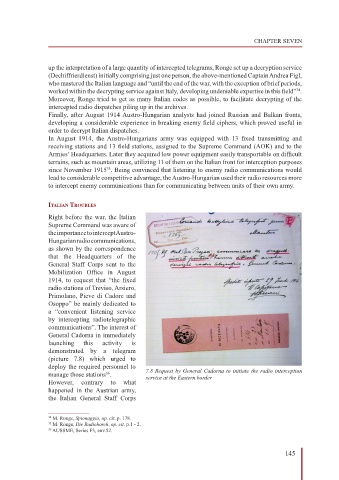
                  demonstrated  by a telegram
                  (picture  7.8) which urged to
                  deploy the required personnel to
                  manage those stations .           7.8 Request by General Cadorna to initiate the radio interception
                                      36
                                                    service at the Eastern border
                  However, contrary  to what
                  happened in the  Austrian army,
                  the Italian  General Staff Corps


                  34  M. Ronge, Spionaggio, op. cit. p. 178.
                  35  M. Ronge, Die Radiohorch, op. cit. p.1 - 2.
                  36  AUSSME, Series F3, env.52.


                                                                                                     145

