


Page 152 - The Secret War in the Italian front in WWI (1915-1918)
P. 152
THE SECRET WAR ON THE ITALIAN FRONT IN WWI (1915 – 1918)


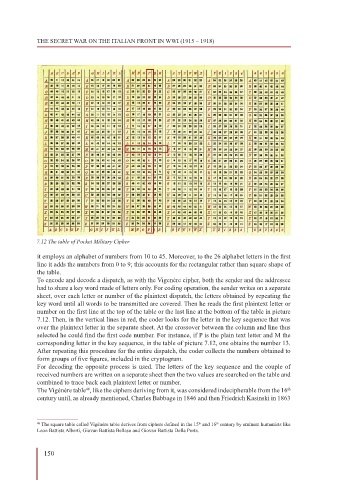
              7.12 The table of Pocket Military Cipher

              it employs an alphabet of numbers from 10 to 45. Moreover, to the 26 alphabet letters in the first
              line it adds the numbers from 0 to 9; this accounts for the rectangular rather than square shape of
              the table.
              To encode and decode a dispatch, as with the Vigenére cipher, both the sender and the addressee
              had to share a key word made of letters only. For coding operation, the sender writes on a separate
              sheet, over each letter or number of the plaintext dispatch, the letters obtained by repeating the
              key word until all words to be transmitted are covered. Then he reads the first plaintext letter or
              number on the first line at the top of the table or the last line at the bottom of the table in picture
              7.12. Then, in the vertical lines in red, the coder looks for the letter in the key sequence that was
              over the plaintext letter in the separate sheet. At the crossover between the column and line thus
              selected he could find the first code number. For instance, if P is the plain text letter and M the
              corresponding letter in the key sequence, in the table of picture 7.12, one obtains the number 13.
              After repeating this procedure for the entire dispatch, the coder collects the numbers obtained to
              form groups of five figures, included in the cryptogram.
              For decoding the opposite process is used. The letters of the key sequence and the couple of
              received numbers are written on a separate sheet then the two values are searched on the table and
              combined to trace back each plaintext letter or number.
              The Vigènére table , like the ciphers deriving from it, was considered indecipherable from the 16
                               48
                                                                                                      th
              century until, as already mentioned, Charles Babbage in 1846 and then Friedrich Kasinski in 1863


                                                                       th
                                                                             th
              48  The square table called Vigénère table derives from ciphers defined in the 15  and 16  century by eminent humanists like
              Leon Battista Alberti, Giovan Battista Bellaso and Giovan Battista Della Porta.

                150

