


Page 149 - The Secret War in the Italian front in WWI (1915-1918)
P. 149
CHAPTER SEVEN


                  The red code
                  The second edition of the Red Code, published on 30 June 1915, derived directly from the first
                  edition of 1898, when the Intelligence Office included only one Official, the Colonel Felice De
                  Chaurand de Saint Eustache. The new edition of the Red Code - which the Austrians called ‘Red
                  15’ - differs slightly from the 1898 one, because of some amendments and additions.
                  It could be preliminary remarked that this Code, like the Pocket Military Cipher had been in
                  service for many years already, providing the Intelligence of potential enemy Countries with
                  the opportunity to steal them, in addition with offering a considerable quantity of homogeneous
                  cryptographic material. Regardless of their cryptographic validity, it would have been imperative
                  to completely replace all codes and ciphers at the beginning of the war, to avoid serious risks on the
                  communication security.
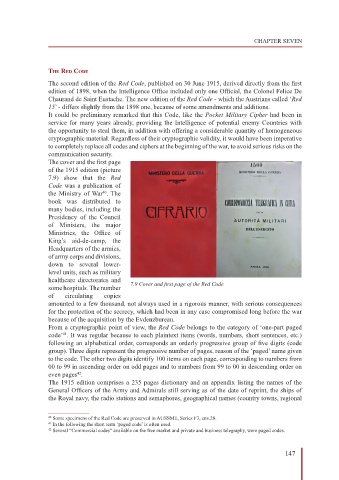
                  The cover and the first page
                  of the 1915 edition (picture
                  7.9) show that the  Red
                  Code was a publication  of
                  the Ministry of War . The
                                     40
                  book was distributed  to
                  many bodies, including the
                  Presidency  of the  Council
                  of Ministers,  the  major
                  Ministries,  the  Office  of
                  King’s aid-de-camp,  the
                  Headquarters of the armies,
                  of army corps and divisions,
                  down to  several  lower-
                  level units, such as military
                  healthcare  directorates  and   7.9 Cover and first page of the Red Code
                  some hospitals. The number
                  of    circulating   copies
                  amounted to a few thousand, not always used in a rigorous manner, with serious consequences
                  for the protection of the secrecy, which had been in any case compromised long before the war
                  because of the acquisition by the Evdenzbureau.
                  From a cryptographic point of view, the Red Code belongs to the category of ‘one-part paged
                  code’ . It was regular because to each plaintext items (words, numbers, short sentences, etc.)
                       41
                  following an alphabetical order, corresponds an orderly progressive group of five digits (code
                  group). Three digits represent the progressive number of pages, reason of the ‘paged’ name given
                  to the code. The other two digits identify 100 items on each page, corresponding to numbers from
                  00 to 99 in ascending order on odd pages and to numbers from 99 to 00 in descending order on
                  even pages .
                            42
                  The 1915 edition comprises a 235 pages dictionary and an appendix listing the names of the
                  General Officers of the Army and Admirals still serving as of the date of reprint, the ships of
                  the Royal navy, the radio stations and semaphores, geographical names (country towns, regional


                  40  Some specimens of the Red Code are preserved in AUSSME, Series F3, env.28.
                  41  In the following the short term ‘paged code’ is often used.
                  42  Several “Commercial codes” available on the free market and private and business telegraphy, were paged codes.


                                                                                                     147

