


Page 150 - The Secret War in the Italian front in WWI (1915-1918)
P. 150
THE SECRET WAR ON THE ITALIAN FRONT IN WWI (1915 – 1918)


              capitals, etc.), for a total number
              of pages amounting to 252. Many
              positions are  empty  and allow
              new items or ‘nulls’, as groups
              with no meaning, to be included
              into dispatches .
                            43
              According to a procedure
              commonly adopted for increasing
              the secrecy of paged codes, the
              page numbering used in coding
              and  decoding could  differ
              from the strictly  progressive
              numbering shown at the bottom
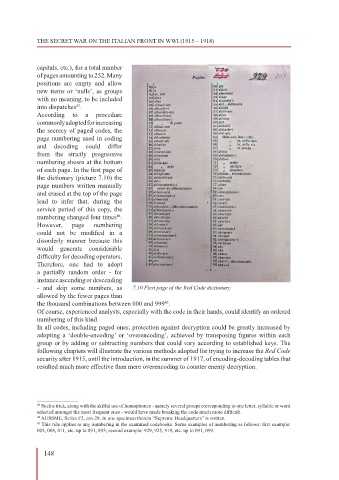
              of each page. In the first page of
              the dictionary (picture 7.10) the
              page numbers written manually
              and erased at the top of the page
              lead  to  infer  that,  during the
              service period of this copy, the
              numbering changed four times .
                                          44
              However,    page    numbering
              could  not  be  modified  in  a
              disorderly manner because this
              would generate  considerable
              difficulty for decoding operators.
              Therefore,  one  had  to  adopt
              a partially random order - for
              instance ascending or descending
              - and skip some numbers, as       7.10 First page of the Red Code dictionary
              allowed by the fewer pages than
              the thousand combinations between 000 and 999 .
                                                           45
              Of course, experienced analysts, especially with the code in their hands, could identify an ordered
              numbering of this kind.
              In all codes, including paged ones, protection against decryption could be greatly increased by
              adopting a ‘double-encoding’ or ‘overencoding’, achieved by transposing figures within each
              group or by adding or subtracting numbers that could vary according to established keys. The
              following chapters will illustrate the various methods adopted for trying to increase the Red Code
              security after 1915, until the introduction, in the summer of 1917, of encoding-decoding tables that
              resulted much more effective than mere overencoding to counter enemy decryption.


              43  Such a trick, along with the skilful use of homophones - namely several groups corresponding to one letter, syllable or word
              selected amongst the most frequent ones - would have made breaking the code much more difficult.
              44  AUSSME, Series F2, env.28. In one specimen therein “Supreme Headquarters” is written.
              45  This rule applies to any numbering in the examined codebooks. Some examples of numbering as follows: first example:
              003, 008, 011, etc. up to 891, 893; second example: 929, 925, 919, etc. up to 091, 099.


                148

