


Page 197 - The Secret War in the Italian front in WWI (1915-1918)
P. 197
CHAPTER NINE


                  Moreover,  the  cipher  indicated  in  point  5  of  the  list  is  exemplified  by  transposition-based
                  cryptograms shown in the following paragraphs, where also an example is exposed of a 3-figure
                  syllabic cipher application that Sacco probably had too (line 6 of the list).
                  The notebook contains many pages full of decrypted or just analysed cryptograms, for the most
                  part, transposition-based ciphers, but also includes mono and poly-alphabetic ciphers.


                  The sTaff

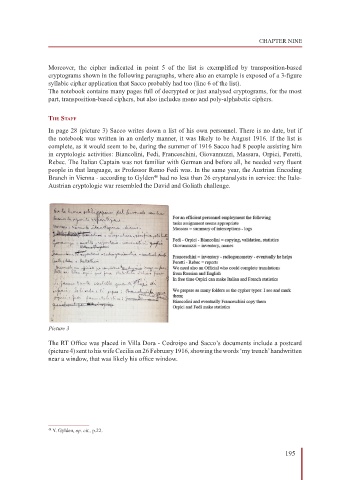
                  In page 28 (picture 3) Sacco writes down a list of his own personnel. There is no date, but if
                  the notebook was written in an orderly manner, it was likely to be August 1916. If the list is
                  complete, as it would seem to be, during the summer of 1916 Sacco had 8 people assisting him
                  in cryptologic activities: Biancolini, Fedi, Franceschini, Giovannuzzi, Massara, Orpici, Peretti,
                  Rebec. The Italian Captain was not familiar with German and before all, he needed very fluent
                  people in that language, as Professor Remo Fedi was. In the same year, the Austrian Encoding
                  Branch in Vienna - according to Gylden  had no less than 26 cryptanalysts in service: the Italo-
                                                       48
                  Austrian cryptologic war resembled the David and Goliath challenge.


                  Picture 3

                  The RT Office was placed in Villa Dora - Codroipo and Sacco’s documents include a postcard
                  (picture 4) sent to his wife Cecilia on 26 February 1916, showing the words ‘my trench’ handwritten
                  near a window, that was likely his office window.


                  48  Y. Gylden, op. cit., p.22.


                                                                                                     195

