


Page 61 - The Secret War in the Italian front in WWI (1915-1918)
P. 61
CHAPTER THREE


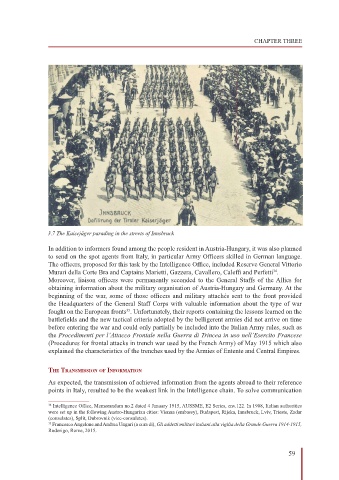
                  3.7 The Kaisejäger parading in the streets of Innsbruck


                  In addition to informers found among the people resident in Austria-Hungary, it was also planned
                  to send on the spot agents from Italy, in particular Army Officers skilled in German language.
                  The officers, proposed for this task by the Intelligence Office, included Reserve General Vittorio
                  Murari della Corte Bra and Captains Marietti, Gazzera, Cavallero, Caleffi and Perfetti .
                                                                                                 34
                  Moreover, liaison officers were permanently seconded to the General Staffs of the Allies for
                  obtaining information about the military organisation of Austria-Hungary and Germany. At the
                  beginning of the war, some of those officers and military attachés sent to the front provided
                  the Headquarters of the General Staff Corps with valuable information about the type of war
                  fought on the European fronts . Unfortunately, their reports containing the lessons learned on the
                                             35
                  battlefields and the new tactical criteria adopted by the belligerent armies did not arrive on time
                  before entering the war and could only partially be included into the Italian Army rules, such as
                  the Procedimenti per l’Attacco Frontale nella Guerra di Trincea in uso nell’Esercito Francese
                  (Procedures for frontal attacks in trench war used by the French Army) of May 1915 which also
                  explained the characteristics of the trenches used by the Armies of Entente and Central Empires.


                  The TransMIssIon of InforMaTIon

                  As expected, the transmission of achieved information from the agents abroad to their reference
                  points in Italy, resulted to be the weakest link in the Intelligence chain. To solve communication


                  34  Intelligence Office, Memorandum no.2 dated 4 January 1915, AUSSME, E2 Series, env.122. In 1908, Italian authorities
                  were set up in the following Austro-Hungarian cities: Vienna (embassy), Budapest, Rijeka, Innsbruck, Lviv, Trieste, Zadar
                  (consulates), Split, Dubrovnik (vice-consulates).
                  35  Francesco Angelone and Andrea Ungari (a cura di), Gli addetti militari italiani alla vigilia della Grande Guerra 1914-1915,
                  Rodorigo, Rome, 2015.


                                                                                                      59

